Saturday, May 31, 2025

The negative mass and the interstellar travel.


Above is a fictional interstellar spacecraft. There is a possibility that in the future this kind of spacecraft will be are reality. The idea is that the annihilation in the space system creates an energy impulse that turns the spacecraft's mass virtually negative. But we know that negative mass is impossible at least in technology that we can imagine. But there is a hypothetical model where the system pulls quantum fields into the object from some kind of hole. 

Then the system expands the quantum field inside it. That energy flow makes material virtually negative. The system has a similar effect inside to the ramjet engine there the cone aims air to its shell. That cone heats the air. Then the system injects the fuel into the engine. The similar form in the quantum version is very hard to make. But if the quantum cone that aims the quantum fields in the spacecraft shell is possible, that can turn spacecraft mass virtually negative. That opens our path to the universe. 

Negative mass is a term that means material that will push gravitational fields away from it. There is no negative mass in the universe. The negative mass makes things like WARP bubbles and other things possible, but there is no visible evidence that the mass can turn opposite. The term "white hole" doesn't mean negative mass or material. 

It's the hypothetical point, where energy that comes from the wormhole hits the quantum field.  The negative mass is not possible if the particle cannot send the radiation that fills the gravitational waves. A gravitational wave is the energy ditch that travels in the universe. Its shape can be similar to a false vacuum model. 

Where there is a small energy that travels before the main ditch difference, and the question is why it can cause objects to fall into the gravitational center. This is one way to think about the weak gravity fields.  The negative mass means a situation where the particle sends energy waves that are opposite to gravity waves. That energy fills the gravity waves and makes the straight universe possible. The idea of hypothetical negative mass is it can push gravity waves away from the object. 

Sometimes researchers say that using Casimir plates it is possible to create negative mass. The idea is that the asymmetry between energy levels of the Casimir plants makes an asymmetrical Casimir effect. That creates the energy flow that turns gravity opposite. The idea is that the Casimir plates can create short-term quantum vacuums when virtual particles between them collapse. 

That vacuum bubble will also collapse and it can pull gravity waves in it. And then the asymmetrical energy between those plates will push those waves away. But that requires a very different type of technology than the electromagnetic Casimir plates use. That hypothetical technology makes it possible to create the WARP bubble. So, the negative mass is like a "rocket engine" that pushes those gravity fields away from around it. The problem with negative mass is how that thing can stay in the form of material. The WARP bubble around that material makes it evaporate immediately. 


There are some ideas about the systems that could turn mass virtually negative. Some of those systems base annihilation or material evaporation in the cosmic vacuum voids. 


That means there must be some kind of channel in the middle of the structure that brings energy to the negative mass. Sometimes researchers introduced the idea that the structure would be like graphene. The annihilation system aims for particles and their antiparticle pairs together in the system. The idea is that there are two layers of plates in this system. The other plate has nano-holes. And the other plate is very dense. 

Annihilation between those layers sends radiation out from the structure. And that radiation pushes quantum fields away and forms the WARP bubble. The annihilation can happen between electrons and positrons. But if the system uses quark-antiquark pars that makes it easier to control The other possibility is to use the light cylinder. The giant, hollow laser ray closes the structure inside it. 

That thing can be used to create the quantum vacuum around the structure. The system can look a little bit like a honeycomb. There can be the balls in those honeycombs. Then the system creates the field that closes the honeycomb. After that, it pulls energy fields out from the tube. That causes material evaporation in the balls; their energy is stored in the kinetic form. 

That evaporation where that ball turns into wave movement causes acceleration. So material that turns into energy causes a similar effect to annihilation. The problem is: how to make dense enough materials that they can create an absolute vacuum. 

The small "cosmic void" around material pulls energy out from it. And that causes the material to evaporate. When material evaporates it releases energy so much that it can push gravitational and quantum fields away from it. The problem with the idea of the negative mass is this. Normal material cannot turn negative if we think about its mass. The negative material, or negative mass requires that the system create a dense energy field that pushes all other forces away from the structure. 


https://www.orionsarm.com/eg-article/493edf03965d4


https://en.wikipedia.org/wiki/Alcubierre_drive


https://en.wikipedia.org/wiki/Casimir_effect


https://en.wikipedia.org/wiki/Negative_mass


Friday, May 30, 2025

False vacuum decay.


False vacuum decay is one of the most feared things in quantum mechanics. Another name for that thing is the dimensional collapse. The idea is that all particles involve false vacuums. The small false vacuum forms near superstrings that are the edge of the particle. The quantum low pressure in the particle keeps it in form. Or, the thing that keeps particles in their form is the interaction between the quantum field inside the particle and outside the particle. 

The outside quantum field pushes against the whisk-looking structure of the particle. A particle remains in its form as long as its inner structure is at a lower energy level than outside the particle. The thing that determines the particle's energy level is the elementary particle's shell. If the energy level in the particle rises too high, that rips its structure into pieces. If the energy level in a particle falls too low, that causes the particle's collapse. 

The dimension is energy level. The dimensional collapse can happen internally or externally. In internal collapse, the particle loses its internal energy. And that causes the particle to fall like a balloon that loses its internal pressure. In external collapse the outside energy level drops and that pulls energy out from the particle. 

When particles turn flat it leaves a hole behind it. Particles near that collapsed particle send an energy impulse that falls in the energy pothole, but that energy cannot reach the collapsed particle. And when energy, or wave movement comes from every direction that causes the formation of the energy bubble or dome. 


When outside energy tries to fill that hole that energy must come from somewhere. And that "somewhere" is other particles. That can cause a chain reaction where more and more particles start to lose their energy. The problem is that the wave movement slides over those flat parts but it cannot reach them. 

When lots of energy falls into the same spot from a large area. That can have a very strong impact. That packs lots of energy into one point, and sooner or later the energy load in that point turns so high that it pushes quantum waves backward. That can form a quantum tsunami that destroys lots of things. This explosion can be very strong. 

The other model is that dimension just removed from the people's eyes. The collapse of the energy level in particles causes a situation where the particle turns flat. And then other particles around it lose their energy to that particle. That means that the large particle group can lose its energy in a very short time. That means the particles around those particles turn flat. And that means those particles lose their ability to interact with other particles. Because energy travels always to lower energy points. A particle that falls can collect lots of energy from around it. 


https://www.vice.com/en/article/the-learnin-corner-false-vacuum-decay-0000052-v18n1/


https://en.wikipedia.org/wiki/False_vacuum


Cosmological crisis, and why some stars seem older than they should.


"Scientists have made a new calculation of the speed at which the universe is expanding, using the data taken by the powerful new James Webb Space Telescope on multiple galaxies. Above, Webb’s image of one such galaxy, known as NGC 1365. Credit: Science: NASA, ESA, CSA, Janice Lee (NOIRLab), Image Processing: Alyssa Pagan (STScI)" (ScitechDaily, Hubble Trouble Solved? Webb Telescope Finally Cracks the Universe’s Growth Mystery)

The cosmological crisis should be over. Researchers compared the latest data with distant objects, including black holes and red giants, against the cosmological standard model. Those new observations are in line with the standard model, and that thing solved the crisis. The crisis formed when the universe seemed to expand faster than it should. The question is this: can the universe be a little bit asymmetrical? 

The asymmetry can form for many reasons. One of the reasons why those cosmological asymmetries can form is that the supermassive black hole(es) that could formed just after the big bang can roll material into it. That forms the hole in the material.  And when material travels past that black hole there forms a large pothole in the quantum field. So, if the black hole forms in the young universe just after the big bang it turns into the supermassive black hole. 

So, if part of the material falls back into the black hole, that hypothetical case means that the black hole at the center of the universe gets a companion black hole. The idea is that after the Big Bang which was a series of events. 

Where the material reached the form as we know it. If in a young super energy level universe forms a "Kugelblitz" black hole that black hole will turn supermassive. The denser energy state means that the black hole is very small in a high-temperature universe. But the black hole is an interaction. And when outcoming pressure turns lower that means the black hole can expand its event horizon. 

The idea is that the singularity sends a very high energy, short-wave radiation. That radiation forms a false vacuum around the singularity. The false vacuum forms when a fully symmetrical particle called singularity vaporizes. When that singularity vaporizes it acts similar way as an ice bite that melts in the room. 

There is an interesting theory that the black hole is a false vacuum or vacuum. In the last case, the cosmic void just collapses. If there is some kind of material cloud in the middle of that thing.  Then there forms a formation in the middle of the vacuum that acts like a thermal pump. Actually, the bubble that the energy field cannot press together can also act as a black hole. The idea is that the structure that moves energy or quantum field in two directions can act as a black hole. 

The false vacuums can interact similar way as black holes. The idea is that the false vacuums can surround all gravitational holes or gravitational centers. The question is: what happens if material and energy travel past the gravitational center at a very high speed? There is the possibility that the very fast-moving material and energy flow around the gravity center just pulls that object with it. That means the high-power energy forms a vacuum around the object. 

And that object can vaporize leaving the bubble behind it. If the extremely fast-spinning quantum field around that bubble can keep its form. That can mean that the black hole can be the bubble in the fast-spinning quantum field. 

There is the possibility that sometimes the false vacuum interacts with its environment like a black hole. There is the possibility that a false vacuum accelerates energy flow that jumps over the vacuum. That causes a situation. Where that energy acts like a thermal pump. That pulls energy out from a vacuum. 

That turns deeper and deeper. The idea is that there are also other types of things than just singularities that can form an effect that looks like black holes. And maybe all black holes are not similar. There might be many different types of black holes. 


"Artistic impression of a neutron star that is ‘evaporating’ slowly via Hawking-like radiation. Credit: Daniëlle Futselaar/artsource.nl" (ScitechDaily, Space Everything Evaporates: From Neutron Stars to You, the Universe Is on a Clock)


All material will evaporate. That means material turns into wave movement because the quantum field, or Higgs field turns weaker. And it cannot resist energy flow out from particles. Or it cannot press particles into their form. 


If a star goes into a cosmic bubble or cosmic void that can cause that energy to flow out from the star faster than it should. That can cause opposite time dilation where time moves faster than it should. 

Time dilation is a two-way effect. The time slows in the object when its energy level turns higher. But if the object gets into the cosmic void that causes energy to flow out from that object faster. The cosmic void that forms around the object can turn time travel faster than usual. Time dilation means that when energy flows from the object determines how fast the time moves or travels. 

Another name for the time is the speed of the particle vaporization. When a particle delivers energy it turns older, and when a particle receives energy it turns older. It's possible that very high-energy stars can blow the bubble around them. Or they can travel in the cosmic void, which can cause the opposite time dilation which means the star seems to be older than it should be. 

But the other thing that may look interesting is stars that seem to be older than the universe. There can be situations in which the blue supergiants or hydrogen stars can go near black holes. The black hole can pull material out from the hydrogen star. And then. Another thing is that the black hole can cause time dilation. 

The time dilation can explain why some stars seem to be older than they are. Another thing is that the black holes or their transition disks send energy flow that heats stars around them. When sometimes that energy flow turns weaker that can cause a situation. That causes situations where particles can deliver a little bit too much energy, and their energy level turns lower than it should be. 

In a high energy stars the hydrogen atoms or subatomic particles can also spin very fast. That spin can cause time dilation. In that case, the time should look slowing. But then the high-energy star can blow energy and material away from its environment. That means the energy flows out from the star. And that can form electromagnetic low pressure around the star. That means energy flows away from the star faster than it should. And then that thing makes time move faster than it should. This kind of cosmic void around the stars can explain, why some of them look older than the the universe. 


https://scitechdaily.com/everything-evaporates-from-neutron-stars-to-you-the-universe-is-on-a-clock/

https://scitechdaily.com/hubble-trouble-solved-webb-telescope-finally-cracks-the-universes-growth-mystery/

https://en.wikipedia.org/wiki/False_vacuum


Thursday, May 29, 2025

How to secure a data center's energy supply?


The lack of electricity will shut down almost the entire infrastructure. That means that energy is a good way to blackmail Western society. Damage to energy infrastructure can cause terrible situations. If we think that the entire stale is left without an electricity supply, that causes situations where communication and other things are in danger. 

In petroleum stations, the pumps will not work, and telephones won't work. In the case of the war, military personnel will not get messages to regular mobile telephones. 

But what if only the data center or computer infrastructure will shut down? In the military world, computers will control things like air defense systems whose mission is to shoot down enemy missiles. 

The data center requires a lot of electricity. Those data centers can play growing roles in national security and military systems. The robots that operate on the field outsource their complicated data handling processes or "thinking" to those systems. The robot communicates with the data center. There is the AI that connects all systems on fields under one dome. Data centers also play a big or even dominating role in a modern environment. 

Communication between the data center and field-operating systems happens using relay aircraft, stratospheric satellites, and satellites. The term stratospheric satellite means drones that have the same missions as communication or some other satellites. 

The growing role of the data centers causes situations. Where those systems are more and more attractive targets for enemy attacks. The high-power EMP weapon or nuclear- or conventional strike against data centers or their communication can destroy or damage the brains of the systems.  

One of the answers to the power supply problem can be the miniature nuclear reactors. The mini-nuke or portable nuclear reactors offer a good alternative for power supply. But there is always a small possibility that somebody tries to damage those miniature nuclear reactors. The miniature nuclear reactor uses molten salt for cooling. They can offer a solution that separates the data center from the power network. 


Orbital data centers, are they the answer to the data center's energy problems? 

Orbital data centers are solutions that address energy challenges faced by data centers. The orbital data centers can be one large satellite. Or they can use cloud-based architecture. The cloud-based system is a swarm of satellites whose computers are connected together. 

The cloud-based architecture means. Those satellite groups or swarms can communicate with each other using radio waves, coherent radio waves, or laser beams. Those laser beams can travel freely in space. Or those satellites can be connected. To each other using optic fibers. Those satellite swarm bases are in the existing technology. 

Those satellites can travel to the orbiter in regular rockets. But the problem is that they must have some kind of protection against solar storms. The satellite swarm must also be far enough from Earth that it can avoid orbital collisions. Things like electromagnetic shields that can push ions away from the satellites are necessary.

And then another thing is that. Those data centers or data satellite swarms's functionality must be confirmed in the case. That somebody tries to damage them. There is always the possibility that somebody puts the nuclear weapons on orbital trajectories. And then detonates that system. That kind of EMP pulse can destroy the satellite's electronics. 


https://www.geeky-gadgets.com/space-based-data-centers-the-next-frontier-in-computing/


https://interestingengineering.com/energy/microreactor-test-beds-power-military-bases


The new GHOST drone can fly days before it attacks.

An artist's render of a General Atomic unmanned aerial vehicle. General Atomics (InterestingEngineering)

New stealth drones are worse than the MQ-9 "Reaper" can ever be. The new GHOST drones have long-lasting capacity. They can fly even days before they start to attack. And those drones can be only the iceberg's top. The fact is that those drones can be more lethal than nobody believes. 

There is the possibility that the quite slow stealth drone can carry hypersonic missiles under or inside them. 

Those stealth systems that are connected with high-speed systems and nuclear weapons are more deadly than ever before. "GHOST will feature a hybrid-electric ducted fan propulsion system designed for stealth and long-endurance missions". (Interesting Engineering, US Air Force’s new stealth drone can fly for days before going for the kill). Hybrid electric fan systems can offer long-lasting capacity for that kind of drone. When a drone attacks, it can accelerate its speed by turning to use the regular turbojet engines. 

This kind of air combat is capable of cruise missiles. AI-controlled kamikaze drones can carry air-to-air and air-to-surface missiles. Those missiles allow the drone to reach the target more likely than if it travels without those sub-missiles. The new kamikaze drones are more versatile than traditional cruise missiles. They can also transmit data about enemy movements. There are rumors about nuclear-powered drones that can patrol in high even years. 


Sceptre (TRBM 155HG). Tiberius. Aerospace 
(ScitechDaily)

When those drones get orders to attack they can use sub-drones. Which means they are drone carriers. Or they can use their internal warheads to destroy targets. 

An interesting possibility is to integrate the new supersonic artillery shell with the drone. Those Tiberius Sceptre shells use the ramjet engine to give them speed over Mach 3.5. There is a possibility. To install those shells into drones, helicopters or even aircraft. There is a possibility to engine a ramjet engine without an artillery socket. So. Aircraft can use the shell simply by dropping them. The helicopter can use the Sceptre grenade that is installed in the rocket. Or it can be shot from the electric launcher that allows the socket to move backward. 

That eliminates the recoil. The small size is 155 mm X 155 cm. makes that system hard to defend. And that system can act like "Super HiMARS" but it's more advanced. The system uses a hybrid GPS-inertial homing system. That is immune to the GPS jammer. Maybe, quite soon those grenades get the image-comparing homing system. Those systems allow them to aim at the target with very high accuracy. 

The artillery shell is possible to integrate with a rocket that uses RDX or some other very fast-burning propellant. That kind of thing can give that ammunition the flight speed that allows it to attack against targets that are over 140 kilometers from the drone. That range is calculated from the standing cannon. The real strike distance from the aircraft or drone is much longer. The shell will get more speed from the aircraft's speed. The new artillery shell can also be integrated into helicopters. The shell can be launched by using the plier-shaped launcher. That launcher integrates an electric arc in the grenade socket. When the propelling charge ignites the socket will go backward. And release the grenade to forward. 


https://defensescoop.com/2023/03/08/darpas-longshot-air-launched-drone-program-approaching-key-milestones/


https://interestingengineering.com/innovation/us-new-ghost-strike-recon-drone


https://interestingengineering.com/military/worlds-first-supersonic-artillery-shell-unveiled


https://www.tiberius.com/sceptre-specs


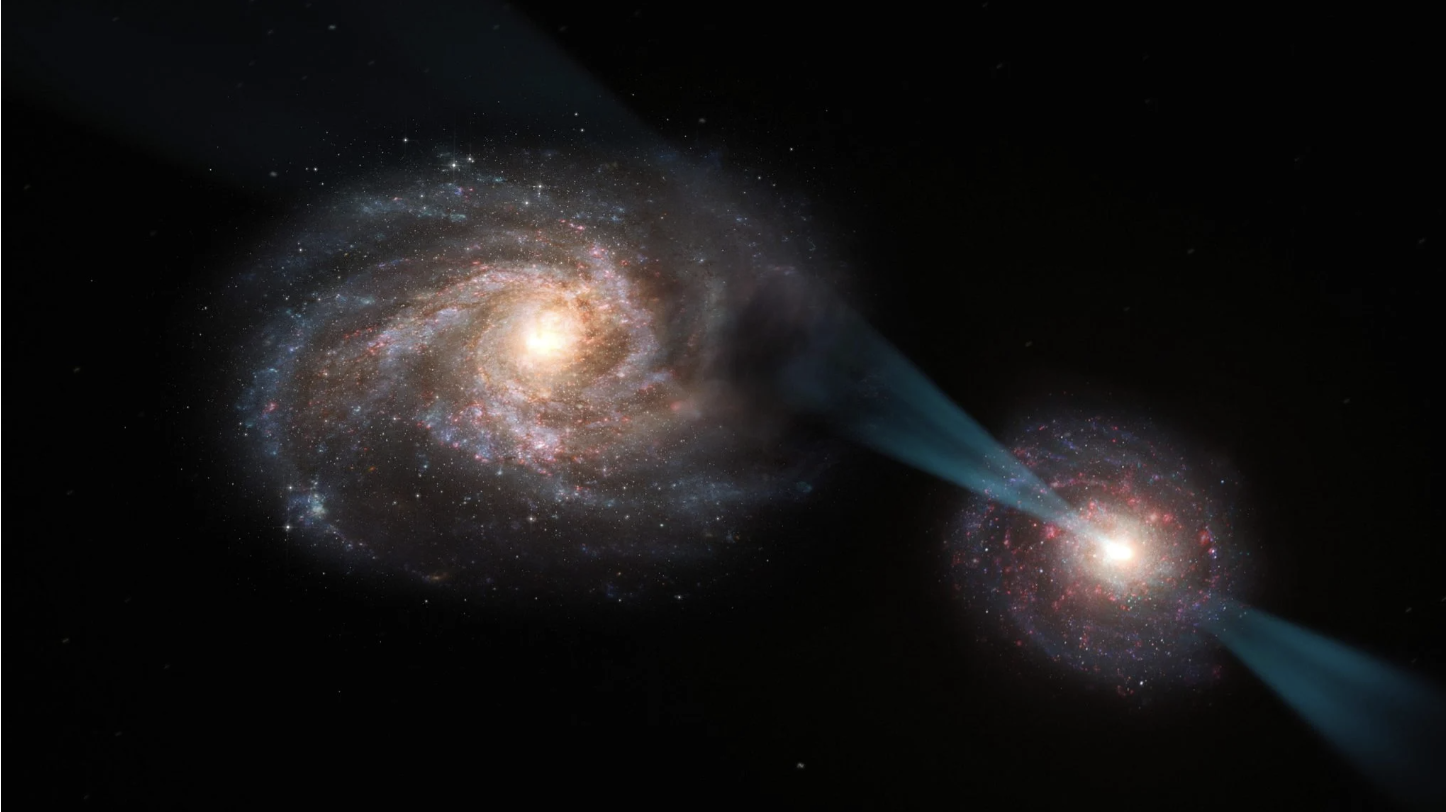
A giant black hole sent a neutrino beam without a flash of visible light.


"This artist’s impression shows a ‘cosmic joust’ – a galactic merger in which the galaxy on the right hosts a quasar at its core. This quasar is powered by a supermassive black hole swallowing up material around it and emitting a powerful cone of radiation, piercing the other galaxy like a lance. As this radiation interacts with the galaxy on the left, it disrupts the clouds of gas and dust within, leaving behind only the smallest and densest regions. These regions are likely rendered incapable of star formation after the process. Credit: ESO/M. Kornmesser" (ScitechDaily, Quasar-Powered Galaxy Attack Revealed in Stunning Detail)

Gamma-rays and galactic-scale quantum annealing. 

There are expectations that those neutrinos formed when high-energy gamma rays hit helium atoms nuclei. That thing can tell something about how neutrinos form. There is the possibility that gamma rays push those helium nuclei quantum fields. And then they can form the "droplet" or the bag from that quantum field. That "bag" is the neutrino that travels through the universe. 

If a neutrino's form is very flexible that means there is the possibility that the neutrino puts the fields around them to travel past them with minimum contact or minimum energy transfer. But that is only a hypothesis. The thing that makes neutrinos almost massless is the minimum energy transfer between them and their environment. 

The energy that comes from distant supernovae and quasars can create gamma rays. When we think about things. Like a cosmic gamma-ray background, there is a possibility that things like black holes in the Milky Way disturb that image. The energy that forms in the Milky Way causes annealing in our galaxy dust and gas. 


"Schematic diagram of how neutrinos are produced by the decay of neutrons produced by photolysis of nuclei. Credit: Yasuda et al." (ScitechDaily, The Squid Galaxy’s Black Hole Just Unleashed a Neutrino Storm Without the Light)


"Hubble image of the spiral galaxy NGC 1068. Credit: NASA / ESA / A. van der Hoeven" (ScitechDaily, The Squid Galaxy’s Black Hole Just Unleashed a Neutrino Storm Without the Light)


Sometimes, some galaxies have very active quasars as their companion. Those quasars send high-energy radiation into the galaxy. The power of that energy is so strong that it puts the spiral galaxies's material to anneal. That energy boosts star formation. But it can also make it possible to test things like time dilation in the large-scale environment. The time dilation means that energy flow from particles turns slower. 

And the energy from the quasar raises the energy level in that galaxy. When the environment's energy level rises, energy flow from particles decreases. If the environment reaches the same energy level with particles those particles will vanish. The existence of particles requires that there is a difference in energy levels between the particle and its environment. The energy level in a particle cannot go below the universe's energy minimum. 

An interesting case would be the situation where the jet from another supermassive black hole hits another black hole. Or supermassive black hole's relativistic jets impact with another black hole's relativistic jet. That energy will push every particle into the form of a black hole. That kind of thing can start the quasar formation. Quasars are the first stage in the galaxy formation.


https://scitechdaily.com/quasar-powered-galaxy-attack-revealed-in-stunning-detail/


https://scitechdaily.com/the-squid-galaxys-black-hole-just-unleashed-a-neutrino-storm-without-the-light/


Wednesday, May 28, 2025

Do black holes require singularity?

Quanta Magazine


There is the possibility that black holes have no singularity. The question about that case requires an extra claim. That claim is this: is it possible that all black holes are not similar? The black hole can be only the energy tornado that conducts energy out from a certain point. Or it can be the singularity where there is a hole in the middle of it. 

In the gravitational models the gravitational center hovers above the quantum field. We want to use 2D models for 3 or more dimensional objects. 

The quantum tornado pulls energy to the particle. When the object or gravity center pulls energy out from the quantum field those things may explode. When the gravity center pulls energy out from its environment fast enough it creates a pothole. If the particle or object is below the pothole's edge it turns invisible. 

When the particle falls below the pothole's edge. It turns invisible. That means it turns into a black hole. But then. We can think about the case that a very small particle starts to pull that energy tornado against it. Then the particle will suddenly jump forward when its size turns smaller. That thing can make it possible for an energy tornado to close the object inside it. The energy tornado is the superstring. 

The energy flow between a particle and its environment is a little bit asymmetrical. Because the past is at a higher energy level than the future that makes the particle move through the time. The object acts like a drill that travels in time. The quantum tornado travels forward in time. Until it reaches the higher-energy object. 

That makes information travel backward in the quantum tornado. The quantum tornado is a complicated rope-shaped structure in which multiple independent superstrings are formed. The thing that prevents us from seeing the future is that those superstrings don't transport information synchronously. Their lengths are different. And they transport information to different places in spacetime. 


The light cone can also introduce situations where two quantum fields impact each other in fast-spinning particles. The space asymmetry in space inside the particle makes energy travel out from it from its "equator". The energy from the outside tries to push that energy in. The energy tornado that takes energy out from the middle of the object determines which direction energy travels. Normally energy travels into the energy tornado. But there are moments when the energy level in the tornado's shell turns so high that it pushes the falling quantum field outward. 

So if we want to make the causality loop we should know the ultimate end of some of those superstrings. We must separate that superstring from others. Then we must create a high-energy spot into that point so that it can press information backwards. The thing that must be in the past is the false vacuum. 

The bubble where the energy level is lower than the point in the future allows information to travel back to the past. The low energy bubble is needed, because otherwise information faces resistance. And that resistance disturbs the information. Same way as we try to send water flow through the tube from both of its ends at the same time. 

The energy pothole that denies the particle to release its energy. And keeps it in its form. Time is energy. When a particle evaporates and turns into energy. That means it turns old. But if the particle cannot release its energy that means it will not turn old. If a particle receives energy it turns younger. Time dilation means the particle's ability to release energy. If a particle cannot release energy it will not turn old. The particle can only receive, store, and release energy. 

The expansion of the universe turns the quantum field around the particle or object weaker. That means an object's energy level rises higher compared to the quantum field around it. That makes energy travel out from the object faster. If the quantum field around the object is lost, that means energy travels out from the object at a very high speed. 

The mass of the particles depends on their spinning. The ability to bind quantum fields makes their mass. But if the particle spins incredibly fast. There is the possibility. That the particle cannot bind quantum fields from around it. If the particle is like a whisk. That structure is formed of the superstrings that must let the quantum fields travel between them. If the spin speed is fast enough the particle starts to behave. A little bit strange. 

The particle's spin makes the energy tornado at its spin axle. Then the quantum field starts to fall against the particle. The quantum tornado turns longer. That energy that comes from the tornado pushes particles into the flat. The energy travels into particles from the spin axle energy that comes from the up and down spin points ("poles") impact in the middle of the particle. 

In the particle's equator is the quantum asymmetry. That causes a situation in which the particle sends wave movement from its equator. When the spin of the particle is fast enough the quantum tornado makes a hole in it. The quantum tornado can have multiple layers. The whirl is always a special formation. Their walls are always at a higher energy level than their internal structure. The energy that travels in the energy tornado or energy whirl keeps it open. 

Energy fields that impact in the middle of the particle turn the energy level inside it into a very high level. That presses the particle flat and then the spinning structure guides the energy out from its equator. That energy flow rips particles in pieces. 

So, what connects that thing with gravity? The particle cannot get its energy from emptiness. When a particle pulls energy inside it it makes the energy pothole around it. The quantum tornado pulls energy to the particle. The energy destroys the particle if its pothole is not deep enough that it can press that energy back to that particle. 

When an object or particle pulls energy from the environment that energy destroys the structure. There is another way to think about that process. When a particle or object starts to spin and turns flat that plate pulls energy away from its environment. But that energy comes mainly from above and below. 

The plate itself conducts energy to its sides. The energy starts to form another energy tornado that allows the particle to form the quantum bubble over it. That bubble denies seeing the particle. If there is a hole in the particle the energy tornado travels through that structure. That structure can pull energy into the middle of it, even if it rotates very fast. In that case, the requirement is that the quantum tornado can transport energy very fast through the structure. This kind of thing is the model of the black hole. 


https://www.quantamagazine.org/singularities-in-space-time-prove-hard-to-kill-20250527/


Tuesday, May 27, 2025

Quarks, gluons, and symmetry.


"A recent experiment led by Mississippi State physicist Dipangkar Dutta has shaken one of physics’ most reliable concepts: symmetry. Credit: Shutterstock" (ScitechDaily, Rethinking the Universe: New Findings Rewrite Rules of Subatomic Matter)


The new research breaks the rules of physics. When an electron collides with quarks, it will not always decay and reassemble symmetrically. That means there is a problem with symmetry in the quarks. The Pauli exclusion principle, which states that no two identical fermions can occupy the same quantum state in the same system, explains many aspects of the existence of atoms and subatomic particles.

Because those particle's energy levels are different. That difference causes energy flow. That keeps them in their entirety. 

If there are two identical fermions. That causes the quantum flash that pushes those particles away. When quarks decay they can reassemble themselves. That requires that both of those parts are in the same quantum field. 

That quantum field is like the bag that denies the quantum shadow, or quantum bridge fill. That quantum shadow pulls those quark's halves back together. But there seems to be a situation where when an electron hits quakes the quantum field fills that bridge. If a quantum field turns between parts of a decayed quark, that field denies their reassembly. 

There is also the possibility that if those decayed parts of the quarks spin oppositely that event turns the quantum field between those particles into a shape that looks like twisted fabric. That means the energy density or energy level between those particles rises so high, that they cannot cross that bridge. That is one of the most interesting things in modern physics. That helps researchers make models about the strong interaction. 

Because energy travels from quarks to gluons. Gluon aims for energy flow to the outside. Because energy travels from quark to gluon, that acts like a thermal pump. It keeps those quarks close to each other. The reason why gluons can bind quarks together is that it cannot get energy from emptiness. It collects that energy from the system where it exists. 


The idea is that quarks spin. The spinning quarks also bind energy into them. The problem is that those quarks sometimes release that energy. That happens when their energy level turns higher than their environment. The gluon is like a thermal pump that aims for energy that the quarks release. 

That means the gluon that is in the quantum shadow between quarks keeps the energy flowing in a certain direction and a certain way. Without gluons, the quarks release their energy symmetrically, and that energy flash pushes those quarks away from each other. The gluon's role in the system is to keep energy flow stable. Because it binds energy from the quark's quantum fields it pulls them into it. That thing causes a situation in which the outside energy starts to push those quarks into the form that we call hadrons. So energy flow between quarks keeps that structure in its form. 

The idea is that the gluon is an extremely fast-spinning particle. That is a little bit flat. That particle binds quantum fields from quarks into the kinetic energy. When quarks come close to each other there forms a quantum (or energy) shadow between them. When gluon spins in that energy shadow it binds energy. 

And deepens that quantum low pressure. This thing stretches those quark's energy fields. Then the fast-spinning gluon binds those fields into themselves. Then the gluon acts like a centrifugal plate that aims energy to the sides of it. Because gluon conducts energy out from the system it pulls those quarks together. Or, otherwise, we can say that outcoming energy pushes quarks near each other. 

If we use a superstring model with gluon that thing looks like the plate that is formed of the strings or wires. Or, otherwise, it looks like a flat whisk. Those wires, or superstrings throw quantum fields to the sides of that particle. The gluon allows the quantum spikes that the quarks stretch quantum field forms to touch the gluon. The gluon aims energy out from them. And that forms quantum low-pressure. 

The strong interaction is the thing that keeps protons and neutrons in their form. In those hadrons, the outcoming energy or quantum fields push quarks so that they can keep their formation in hadrons. That means there is so-called quantum low-pressure that keeps quarks in the forms of protons and neutrons. 

There are models where the gluon. The strong interaction transmitting particle spins between those quarks. That means gluon binds energy into itself. When gluon touches the quantum field around it binds that field into the kinetic energy. That energy pulls the quarks together. When gluon goes between quarks. It pulls energy from the quark's quantum fields. That thing makes those fields stretch. And the gluon simply conducts energy out from that point. 


https://scitechdaily.com/rethinking-the-universe-new-findings-rewrite-rules-of-subatomic-matter/


https://en.wikipedia.org/wiki/Gluon


https://en.wikipedia.org/wiki/Hadron


https://en.wikipedia.org/wiki/Quark


https://en.wikipedia.org/wiki/Standard_Model

Researchers are trying to create new alternatives for rockets.


"Illustration of an imaginative artwork depicting satellites piled up like a stack of pancakes. Image generated by AI." (Sustainability-times, Unstoppable Satellite Barrage: US Firm’s Hypersonic Cannon Fires Pancake Probes Into Space, Prompting Urgent Chinese Response)

Space rockets are tested and good systems for launching satellites into orbiters. But there is one problem with rockets. They are so noisy. And they need lots of space around them. There are a couple of alternatives. Researchers are trying to develop to replace those noisy systems. The easiest to make are the blimps, high-altitude unmanned airships that rise small Pegasus-type rockets to the edge of space. 

Those rockets will launch into orbit from the 40-kilometer altitude. The unmanned robot airships can use hydrogen for hovering, and explosions will not be dangerous to humans on board. Those systems are quieter than the regular rockets. 

The other version is the hypersonic aircraft that makes the ballistic jump. The satellite will release at the top point of the trajectory. Or the aircraft can pull that satellite behind it in the hypersonic glider. And when that aircraft makes the ballistic movement the satellite follows it. And then the ballistic movement acts like a sling to that satellite. 

Centrifugal launchers or spin launchers are tools that can replace rockets.  In those systems, the spinning plate accelerates the satellite at a very high speed. The spinning plate should be very large so that it stands for the spinning speed. If there is some kind of error the centripetal force destroys the plate. There is a possibility of connecting the spin launchers with magnetic accelerators, which can be connected to the stratospheric tube. 


The orbital centrifuge cannon can look like this. The image was made with AI. 


The tube itself can be connected with quadcopters. And it can have a telescopic structure. That means the system can push the stratospheric together. When the system is in use those quadcopters and electric motors pull that tower in full length. When the spin plate accelerates at full speed the system will open a hatch. 

At the top of that thing. Then it opens a ventilator that brings air behind the satellite. The magnetic track and pressure along with the magnetic system pull the satellite through the tube. Those satellites will not be very large. They can be about 1-2 kg microsatellites. Those satellites are packed in the aerodynamic shield. 

There are many variants of spin launchers. The laser system. That shoots below the satellite. Can give extra thrust. The system needs four lasers around the exit tube that give a stable push for the satellite capsule.  

There are models where the system throws the satellite to the ballistic, or suborbital trajectory. Then the small space shuttle, or space hook. That is connected to the space station or heavier satellite pulls that satellite upward. The orbital system catches the satellite. And pulls it upwards.  

In some models, the robot airships can carry extremely long whips. The spin launcher is like the Kevlar or spider silk rope. The rope will spin at a high speed. The length of that whip can be even kilometers. In some plans, there is a space station between Earth and the moon. There the whip length is enormous. 100 or even 1000 kilometers throw the small probes around the solar system. 

The thing is that the centrifugal canons that are connected with magnetic accelerators can be used in long-range artillery. Those systems can launch ammunition over long distances. When we think about the orbital spin launchers those systems can look like helicopter rotors. They can pull themselves into a small size. Then the origami-style system puts its structure into the full size. The magnetic accelerators can be put in the tubes. That is in the middle of solar panels. Those "space windmills" can send metal ammunition against targets at a very high speed. 


https://www.sustainability-times.com/energy/unstoppable-satellite-barrage-us-firms-hypersonic-cannon-fires-pancake-probes-into-space-prompting-urgent-chinese-response/

The new bacteria tell us that life can be weirder than we can imagine.


"Rice scientists found bacteria that breathe by releasing electricity, revealing a natural process with major clean tech potential. (Artist’s concept.) Credit: SciTechDaily.com" (ScitechDaily, Scientists Discover Bizarre Bacteria That “Breathe” Electricity Instead of Air)

If we want to find alien life, we don't need to search for it from another planet. We can find bizarre creatures on our planet. The electricity-breathing bacteria is a good example of that thing. 

Bacteria that breathe electricity instead of air can make new biosensors possible. Those bacteria push electrons into their surroundings. This allows them to eliminate the need for oxygen. This kind of bacteria can turn anaerobic environments and processes more effective. That kind of bacteria can keep those ecosystems in balance. That makes those bacteria very effective tools in bio- and nanotechnology. 

But it can also help to make models. About another planet's possible biospheres. The bacteria that don't need free oxygen are possible. There is lots of oxygen in the water. That means that bacteria must only break water molecules in their cell organelles so that they can live in water worlds. The thing is that those kinds of lifeforms can exist. 


"Possible signs of life on a distant planet? Not so fast. New research shows the signal might just be ordinary molecules, not alien biology. Credit: SciTechDaily.com" (ScitechDaily, Is It Alien Life – or Just Ethane? Scientists Reassess Webb Telescope Discovery)


"This artist’s impression shows what the faraway planet K2-18b, its host star and an accompanying planet in this system might look like. A new University of Chicago analysis has cast doubt on an earlier finding that concluded data showed evidence for life on the planet. Credit: ESA/Hubble, M. Kornmesser" (ScitechDaily, Is It Alien Life – or Just Ethane? Scientists Reassess Webb Telescope Discovery). 

The problem with that thing is distance. That means that life on that planet remains open. And we can discuss that thing endlessly. There was a little bit of ethane and dimethyl phosphine in the spectral analysis. Chemists can produce those compounds in the laboratory but they are also formed in biological processes. 

That means they might be far from things that we used to think or see. When we think about planets that are more than hundreds of light years away from Earth. We cannot be sure if there are some life forms. Before we visit that planet. The JWST telescope's new observations are things that cause discussions and divide opinions. The new observations tell us that those molecules can be just ethane, not biological processes. And then again, what were they before? 

There was ethane on some exoplanet (K2-18b) and that's it. Confirming those alien creatures' existence or non-existence requires far more advanced methods than even the JWST telescope can give. The JWST is an impressive tool. But it cannot find bacteria over hundreds of light years. On earth, ethane forms in biological processes. But it's possible to create that compound in the laboratory. 

The sign of dimethyl sulfide was much weaker than the ethane. But the main question is, why is that signal so weak? Did light travel through something that we cannot see? There are many things and a great distance between K2-18b and Earth. That means the measurements are difficult. Distance to that object is 124 ly. That means we see things that happened 124 years ago. And the primitive lifeforms are always hard to detect. 

But when we think about the bacteria that replace air using electricity. We face an interesting possibility. There is the possibility that somewhere on some other planet live organisms that use electricity to produce oxygen from their environment using electric processes. Theoretically bacteria or, why not, more complicated lifeforms can produce oxygen by using electric processes. The bacteria must have the ability to break water molecules in their cell organelles. That can happen by using electrolysis. 

Those kinds of organisms are not living on Earth. But maybe those things can live in some planet's atmosphere if there is enough water vapor. Those electric-eat bacteria should be investigated more because they could explain why some people are so tired. If that kind of bacteria is near the nervous system, it can make low voltage or disturb electric signals in the nervous channel or axons.


https://scitechdaily.com/is-it-alien-life-or-just-ethane-scientists-reassess-webb-telescope-discovery/


https://scitechdaily.com/scientists-discover-bizarre-bacteria-that-breathe-electricity-instead-of-air/


Monday, May 26, 2025

Could photons support string theory?


"The gravity quantum field is calculated in flat spacetime. The curved classical metric is calculated using the expectation value of the gravity quantum field. Image: Mikko Partanen and Jukka Tulkki / Aalto University." (Aalto, New theory of gravity brings long-sought Theory of Everything a crucial step closer) 

The photon is a donut-shaped strange particle. That particle has no mass. That makes photons interesting. There is a model that photons are the shine that surrounds small gravity potholes. In the gravity model the gravity hovers in the gravity pothole. The gravity center binds energy inside it. That creates the pothole. So if there is an invisible particle above (or front) of a photon that particle binds energy inside it. 

When outcoming energy hits that particle's quantum field that forms the ring, or donut-shaped energy field that could be a photon. So can the mysterious, hypothetical graviton particle that transports gravity be the thing that we can find when we research photons? 

In string theory. All superstrings that can form material are wormholes. The wormhole is a tight energy tube that closes energy inside it. And then that string, or an energy tube. Offers a shortcut to the future. The tight structure of the wormhole prevents the energy travel out from the particle. That means that there is no time in a wormhole. The wormhole is an energy tornado that closes information inside it. 

When energy travels in the wormhole it makes its edge shine. That shine forms when energy interacts with that tube. The interaction is similar to the case in which high-speed airflow travels into the tube. That thing puts the tube's edge anneal. The same way the hypothetical superstring's edge will anneal. 


"A new theory, that explains how light and matter interact at the quantum level has enabled researchers to define for the first time the precise shape of a single photon. Credit: Dr. Benjamin Yuen" (ScitechDaily, Quantum Leap: Scientists Reveal the Shape of a Single Photon for the First Time)

That causes questions about the photon. Could photons be the edge of those microscopic wormholes? In string theory, the superstrings form reality. When those strings turn into tight rolls they form the wormholes. And in Stephen Hawking's model, the universe is full of tiny wormholes that are smaller than quarks. 

The quantum tornado's energy level is so high that particles and energy cannot escape from that tunnel. When radiation or wave movement travels through the wormhole. They form the cosmic thermal pump that pulls energy into that structure. 

When we closely look at the string models we can see one. A very impressive thing. In string models. Strings that form material can turn into a roll. Those rolls can be billions of lightyears long. And that makes them transport energy from the past to the future. The string must be long enough that the energy that travels through it can keep it open. That causes one very interesting idea. 

Can the photon be the edge of the string that anneals when energy travels through it? That explains the photon's strange behavior. How can that particle exist without mass? Could the photon be the edge of the wormhole? If that is true that explains why photons lack mass. 

Or maybe the photon is the edge of the gravitational pothole. That surrounds every particle in the universe. When we look at the gravitational models the particle with mass hovers above the gravity pothole. That is below and around it. In that model, there is an invisible particle above the photon. That particle makes the gravity pothole and the photon is the shine around it. So can we find a graviton in the middle of the photon, as I wrote at the beginning of the text? 


https://www.aalto.fi/en/news/new-theory-of-gravity-brings-long-sought-theory-of-everything-a-crucial-step-closer

https://scitechdaily.com/quantum-leap-scientists-reveal-the-shape-of-a-single-photon-for-the-first-time/

https://en.wikipedia.org/wiki/String_theory


String theory and material.


"Six-dimensional shapes called Calabi-Yau manifolds (3D slices of which are shown here) come in increasingly complicated varieties. In string theory, a microscopic manifold lies at every point in our 4D universe and determines the laws of physics we experience." (QuantaMagazine)


Think about the ring that stands and spins around its axle. That object seems like a ball. In string theory, all material is formed of strings. Think about the ring that stands and spins around its axle. That object seems like a ball. In string theory, all material is formed of strings. Those strings can stretch if they get energy from outside. They can turn into spirals and turn around each other. They can also wrap around themselves and each other. Those strings can form tunnels where energy moves from one place to another. 

In this model, the material is the string that looks like a ring spins around its standing axle. That standing axle is another string. The quantum-low pressure locks the ring around that axle. The axle is colder than the ring and that connects the ring-shaped string into it. In the same way standing, and spinning strings look like the ball, because it spins so fast. That means the 3D structure in the material is only virtual. The thing that keeps this structure stable is the tornado-shaped energy field that conducts energy out from the particle in the middle of it. 

So, that thin energy field forms the axle that connects the ring-shaped energy field into it. The idea is that the tornado must not go through that ring. An energy tornado is like a screw that transports energy out of the structure. The ring-shaped energy field stays standing because there is a small weak point in the electromagnetic field around that quantum tornado. 

If that effect happens between molecules we can say that there is an electromagnetic low pressure. That pulls the ring-shaped energy field against that energy tornado. The energy tornado pulls energy out from the ring. That turns smaller. When that ring turns smaller the outcoming energy, or quantum field tries to fill that place. In that case, the ring-shaped energy field sings like some spring.  If the material is the standing ring that spins around the metal stick that explains also dark energy and dark matter. 

That means the particle wobbles back and forth. Because the ring-shaped energy field is not straight it wobbles. The effect is similar as we would put the ring to spin in a position that it will not be standing straight. There is the possibility that the particle, or energy ring spins half-lying position. That means the dark matter can be the string that's half-laying. The dark energy can be the radiation that comes from the point where the energy tornado hits the energy field. That causes quantum friction which sends wave movement from that point in elementary particles. 


**************


In the string model material is like a ring-shaped string that spins around the vertical axle. That axle is the quantum tornado that transports energy out from the middle of the structure. Because that ring-shaped energy field spins so fast it seems like a ball. And that means the particle's 3D structure is virtual. 

In the same way, we see a spinning ring that stands and spins around its vertical axle as a ball. We see the material as a ball. The thing is that if that energy tornado cannot transport energy out from the structure. The energy will break the ring. So, a stable black hole can form only in the case, where the energy can travel out from it. 

Or strings can bind energy into the spinning movement. The thing that destroys black holes and other material is the free energy, not energy, that is connected into its structure. The problem is that the structure’s energy level cannot rise endlessly. When the structure’s energy level turns higher than its environment it starts to send energy, or anneal. Energy cannot stay in place. It always moves to a lower energy level.

If we think that superstrings bind energy, their energy level rises. And then some of those strings get lower energy levels. That makes energy move between these strings. That causes giant energy turbulence that rips the structure open. When those energy strings send energy they form empty space. That increases entropy in the system. And then sooner or later, some of the superstrings cut or form a hole in the black hole structure. That releases energy against outer strings at a very high speed. That energy wave breaks those strings. 


*********'

String theory also explains the existence of the universe like this. Before the Big Bang event. There formed a ring-shaped energy field that started to pack energy inside it. Because that ring- or wheel-shaped string started to spin around its vertical axle and its energy level was higher than the field inside it, that field started to pack energy into one point. The wheel or ring can pack energy until its energy level turns lower than the field inside it. 

That happens when the string's size turns larger and it cannot harness energy from outside. If a string pulls energy from inside it that causes a low energy area near it. The idea is that the field inside that string is actually, many internal strings. And then some of the strings inside that giant ring-shaped steering string cut. 

That causes energy flow against that string. The effect of energy depends on the area and the speed of the energy effect. The small-diameter bullet penetrates the target better than large diameter bullet if the energy that it sends is the same because its impact area is smaller. And that a small bullet transports more energy at its impact point than a large bullet. 

The nuclear bomb and nuclear power plant involve as much energy. The thing that makes the nuclear bomb more devastating is simple. The nuclear bomb releases its energy in a nanosecond. The nuclear plant uses months or years to release that energy. 


The problem is that the string itself cannot turn larger and keep its energy level stable. 


Because the law of conservation of mass and energy means that the string cannot form energy from emptiness. Mass can change into energy and energy can turn into mass. When it expands there is less energy for its area. When the string's energy level decreases, energy from inside breaks out. 

So, where does that energy ring come from? The natural explanation could be the Phoenix Universe or some other universe. The energy stick that travels through the quantum field can make ring-shaped energy fields like when we throw a stick into water. 

When we use things called earthing we conduct electricity to ground. The thing that turns electricity harmless is it travels into such a large object that its level turns low. The electricity itself doesn't go anywhere. It just travels to such a large object that its level turns so low, that we cannot feel it. So the same energy level or energy mass, if we compare the energy with water can turn devastating, if it's in a small object there it is released very fast. In small-area objects, the fall-altitude of energy is higher than in large-area objects. 

Theoretically it is possible that we can carry electricity in the large plates and then focus that energy on the small plate. The problem is that the energy level in a small object is higher. So we must make a system that pulls energy into the smaller plate from the back of that plate. Another thing is that the energy can travel from a larger area to a smaller area only if the larger area has a higher energy level than the small particle. 

The answer to that question can be a large energy pump that pulls energy out from the back of the smaller particle. The energy flow that comes from the front loads energy to that particle that is between the energy pump and the energy source. This energy makes the star's anneal brighter near black holes. 


https://cerncourier.com/a/testing-times-for-strings/


https://www.quantamagazine.org/ai-starts-to-sift-through-string-theorys-near-endless-possibilities-20240423/


https://en.wikipedia.org/wiki/String_theory


Sunday, May 25, 2025

The leak in speculative execution sent 5000 bytes in a second into the hands of hackers.


"ETH Zurich scientists have discovered a new CPU flaw that lets attackers read private memory from shared Intel processors — exploiting a nanosecond timing glitch in prediction logic. Credit: SciTechDaily.com" (ScitechDaily, Intel’s Memory Leak Nightmare: 5,000 Bytes per Second in the Hands of Hackers)

In modern computing, even nanosecond is a long time. In that time AI can break down defenses using data injection. 

The memory leak left 5000 bytes per second in the hands of hackers. The ability to see the data flow. That comes out from the processor is one of the most dangerous situations in data security. Researchers found vulnerabilities in the actions called "speculative execution". Wikipedia determines speculative execution like this: 

*********************************************************************

Quote from Wikipedia. 

Speculative execution is an optimization technique where a computer system performs some task that may not be needed. Work is done before it is known whether it is actually needed, so as to prevent a delay that would have to be incurred by doing the work after it is known that it is needed. If it turns out the work was not needed after all, most changes made by the work are reverted and the results are ignored.

"The objective is to provide more concurrency if extra resources are available. This approach is employed in a variety of areas, including branch prediction in pipelined processors, value prediction for exploiting value locality, prefetching memory and files, and optimistic concurrency control in database systems."


Overview

Modern pipelined microprocessors use speculative execution to reduce the cost of conditional branch instructions using schemes that predict the execution path of a program based on the history of branch executions. In order to improve performance and utilization of computer resources, instructions can be scheduled at a time when it has not yet been determined that the instructions will need to be executed, ahead of a branch.

Variants

Speculative computation was a related earlier concept.

Eager execution

See also: Eager evaluation

Eager execution is a form of speculative execution where both sides of the conditional branch are executed; however, the results are committed only if the predicate is true. With unlimited resources, eager execution (also known as oracle execution) would in theory provide the same performance as perfect branch prediction. With limited resources, eager execution should be employed carefully, since the number of resources needed grows exponentially with each level of branch executed eagerly.

Predictive execution

Predictive execution is a form of speculative execution where some outcome is predicted and execution proceeds along the predicted path until the actual result is known. If the prediction is true, the predicted execution is allowed to commit; however, if there is a misprediction, execution has to be unrolled and re-executed. Common forms of this include branch predictors and memory dependence prediction. A generalized form is sometimes referred to as value prediction.

Runahead

This paragraph is an excerpt from Runahead.

Runahead is a technique that allows a computer processor to speculatively pre-process instructions during cache miss cycles. The pre-processed instructions are used to generate instruction and data stream prefetches by executing instructions leading to cache misses (typically called long latency loads) before they would normally occur, effectively hiding memory latency. In runahead, the processor uses the idle execution resources to calculate instruction and data stream addresses using the available information that is independent of a cache miss. Once the processor has resolved the initial cache miss, all runahead results are discarded, and the processor resumes execution as normal. The primary use case of the technique is to mitigate the effects of the memory wall. The technique may also be used for other purposes, such as pre-computing branch outcomes to achieve highly accurate branch prediction.

Related concepts

Lazy execution

Lazy execution is the opposite of eager execution, and does not involve speculation. The incorporation of speculative execution into implementations of the Haskell programming language, a lazy language, is a current research topic. Eager Haskell, a variant of the language, is designed around the idea of speculative execution. A 2003 PhD thesis made GHC support a kind of speculative execution with an abortion mechanism to back out in case of a bad choice called optimistic execution. It was deemed too complicated.

Security vulnerabilities

See also: Speculative execution CPU vulnerabilities

Starting in 2017, a series of security vulnerabilities were found in the implementations of speculative execution on common processor architectures which effectively enabled an elevation of privileges


(Wikipedia, Speculative execution)


*********************************************************************


"To compute faster, a predictor in the computer processor anticipates certain calculation steps. Hackers can exploit these anticipations to bypass security barriers and access confidential information. In the illustration, a hacker manages to overcome the protective measures (privileges) at step 3. Credit: ETH Zurich / COMSEC, HK" (ScitechDaily, Intel’s Memory Leak Nightmare: 5,000 Bytes per Second in the Hands of Hackers)

ScitechDaily tells about the new vulnerability like this: 

"Computer scientists at ETH Zurich have uncovered a serious flaw in Intel processors that could let attackers steal sensitive information by exploiting how modern chips predict upcoming actions. Using specially designed sequences of instructions, hackers can bypass security boundaries and gradually read the entire memory of a shared processor. This vulnerability affects a wide range of Intel chips used in personal computers, laptops, and cloud servers."

The Nanosecond Loophole

The so-called BPRC (Branch Predictor Race Conditions) emerge during a brief period of a few nanoseconds when the processor switches between prediction calculations for two users with different permissions, explains Sandro Rüegge, who has been examining the vulnerability in detail over the past few months.

Breaking through the built-in protective barriers between users, known as privileges, is possible because the permissions for individual activities are not stored at the same time as the calculations. With special inputs, it is now possible to cause ambiguity in the sequence of events when changing users, resulting in incorrect assignment of privileges. An attacker could exploit this in order to read an information byte (a unit consisting of eight binary 0/1 pieces of information).

From a Byte to the Entire Memory

The disclosure of a single byte would be negligible. However, the attack can be repeated in quick succession, allowing the contents of the entire memory to be read over time, explains Rüegge. “We can trigger the error repeatedly and achieve a readout speed of over 5000 bytes per second.” In the event of an attack, therefore, it is only a matter of time before the information in the entire CPU memory falls into the wrong hands."

ScitechDaily, Intel’s Memory Leak Nightmare: 5,000 Bytes per Second in the Hands of Hackers


*********************************************************************


We can think of the speculative execution as a secretary, who does some work before the boss gives it to that person. The secretary does the jobs before and then the boss decides if that thing is necessary or should the task be denied. The boss can have the numbers in those papers and if there is a match for the paper, let's say number five, the boss marks the work done. In this case, the boss and secretary are two microprocessors. When some tasks happen very often, the system can perform them.  

The programmed tasks can have tables that are numbered from one to a billion. If the computer makes tasks that include certain actions that match with Table 1 the computer sends the number instead of the entire data to the receiver. The number 1 activates the table that has those actions. 

If there is no match the works are denied. The speculative execution is the thing that works in cases that repeat very often. And the operator can teach new tasks to the computer. 

That action helps intel processors to predict each other's actions. The idea is that the processor makes certain actions after a certain output series. The Speculative execution can be programmed in the microchip's kernel. That means the processor can predict the actions or mark series that other processors can send to it. The system can perform some tasks. Then the system decides if that task is necessary or not. 

This method causes problems. That means that if attackers can download those tables that microchips involve. It causes vulnerability to the system. The ability to get access to data that helps the receiving system to predict the transmitter's actions causes danger. If we think that there is a key code that the transmitter must send the receiver, the receiver can open the message and the system confirms that the data is understood by sending data back. 


If that data matches. With data, that the transmitter should send the receiver can open the data. The idea is the same as a case where a serviceman must open the door. The boss has a copy of the lock in the office.  The serviceman tests the key and sends it back. Maybe there are multiple keys that the serviceman must use in a certain order. If the boss marks the last key that fits to lock that makes it easier to return the system in order, if there is a problem. The system must return to the last key that fits to control lock. 

If the same key matches with the boss's lock. That key is not corrupted. But if the key doesn't work, that means the key is corrupted. And that means the system must return to begin the operations. In that case, the system must get a new key series. In these cases where the system uses the same keys again. That makes it possible to break the algorithms. The attacker must only know the key's code and their order. That makes it possible to open those messages. 

Before today that thing was not a problem. But things like modern drones make it possible to eavesdrop on data that travels in cables in the computer centers. 


https://scitechdaily.com/intels-memory-leak-nightmare-5000-bytes-per-second-in-the-hands-of-hackers/


https://en.wikipedia.org/wiki/Speculative_execution

See also


https://en.wikipedia.org/wiki/Branch_predictor


https://en.wikipedia.org/wiki/Evaluation_strategy#Eager_evaluation


https://en.wikipedia.org/wiki/Meltdown_(security_vulnerability)


https://en.wikipedia.org/wiki/Pipeline_(computing)


https://en.wikipedia.org/wiki/Runahead


https://en.wikipedia.org/wiki/Speculative_multithreading


https://en.wikipedia.org/wiki/Transient_execution_CPU_vulnerability

Saturday, May 24, 2025

Trees communicate before the eclipse.


"Spruce trees can sense and prepare for solar eclipses, aligning their bioelectric activity like a symphony. Older trees appear to lead the process, acting as wise sentinels of the forest. Credit: SciTechDaily.com" (ScitechDaily, Forests “Talk” Before a Solar Eclipse: Study Reveals Mysterious Electrical Communication)

*************************************************

Spruce trees don’t just react to solar eclipses—they anticipate them, synchronizing their bioelectrical signals hours in advance in a display of forest-wide coordination.

This discovery reveals a level of intelligence and communication in trees that rivals animal behavior. Remarkably, older trees lead the charge, hinting at environmental memory being passed down through the forest.

A groundbreaking international study has found that spruce trees not only respond to a solar eclipse but also anticipate it by synchronizing their bioelectrical signals hours in advance, creating a coordinated response across the forest.

Published in the journal Royal Society Open Science, the study shows that older trees display a stronger early reaction, suggesting they hold decades of environmental memory and may play a role in signaling younger trees about upcoming events.

These findings add to growing evidence that plants are active, communicative members of their ecosystems, capable of complex and coordinated behaviors similar to those observed in animal groups.

https://scitechdaily.com/forests-talk-before-a-solar-eclipse-study-reveals-mysterious-electrical-communication/

*************************************************


We have all seen solar eclipses. Before that event nature seems to turn silent. And maybe that thing is not just a feeling.  International researchers noticed that spruce trees communicate with each other before an eclipse. Or, they synchronize their electric behavior before that event. 

Plant intelligence is one of the least researched things in the world. We know that trees and vegetables somehow communicate with each other. When we look at things like flowers, the shape is similar to radio telescopes. And fungus´', or mushroom's shape is similar to the Tesla coil. And we can imagine that those things can send some kind of impulse to each other. We can notice that some flowers like moonwort and other composite flowers have structures in their flowers that seem like axons. 

During international research, they noticed a mysterious electric communication between spruce trees before the solar eclipse. And that thing causes questions about plant intelligence. That is the sign of animal-like behavior. And that kind of communication can help to predict things like earthquakes, volcano eruptions, and other things that can damage them. If the communication is limited to dangerous things. Volcano eruptions are dangerous for those trees. But what do those trees make when they get signals that some volcano is erupting? 

But the question is, how complicated is that communication? If trees send information about the danger. That comes from the ground, what else can they communicate? What else do those trees tell each other? The fact is that nobody communicates for nothing. Do trees share information about thunderstorms and how complicated and accurate could that communication be? 

*********************************************************

“By applying advanced analytical methods—including complexity measures and quantum field theory—we have uncovered a deeper, previously unrecognized dynamic synchronization not based on matter exchanges among trees,” said Professor Chiolerio.

“We now see the forest not as a mere collection of individuals, but as an orchestra of phase-correlated plants.”

(ScitechDaily, Forests “Talk” Before a Solar Eclipse: Study Reveals Mysterious Electrical Communication)

*********************************************************

But the question is, how complicated that communication is? If trees send information about the danger. That comes from the ground, what else can they communicate? What else do those trees tell each other? The fact is that nobody communicates for nothing. Do trees share information about thunderstorms and how complicated and accurate could that communication be? 

"The Gaia hypothesis, also known as the Gaia theory, Gaia paradigm, or the Gaia principle, proposes that living organisms interact with their inorganic surroundings on Earth to form a synergistic and self-regulating complex system that helps to maintain and perpetuate the conditions for life on the planet." (Wikipedia, Gaia hypothesis)

The bioelectric phenomenon in the trees and vegetables is one of the things that allows the trees to have similar processes as our neurons have. Things like pollen can also act as neurotransmitters. That transports information between trees. 

Pollen transports genetic data that allows trees or plants to make the seedlings. But the DNA could also transport other information between individuals. The DNA controls all actions in the cells. The DNA can also control cells to give electric impulses to neurons.

This is one of the most interesting and, at the same time, mysterious things in the world. And that is one of the things. That we should research more. The DNA molecule and cell that gives electric or bioluminescence impulses can act as the data transporter between computers. That technology also allows us to transport memories to the neurons in the case of neural damage. 


https://scitechdaily.com/forests-talk-before-a-solar-eclipse-study-reveals-mysterious-electrical-communication/

https://en.wikipedia.org/wiki/Gaia_hypothesis


Mars was once a tropical paradise, scientists suggest.

“Kaolinite-rich rocks found by Perseverance hint that Mars may once have had warm, rain-soaked environments, offering new clues about the pl...