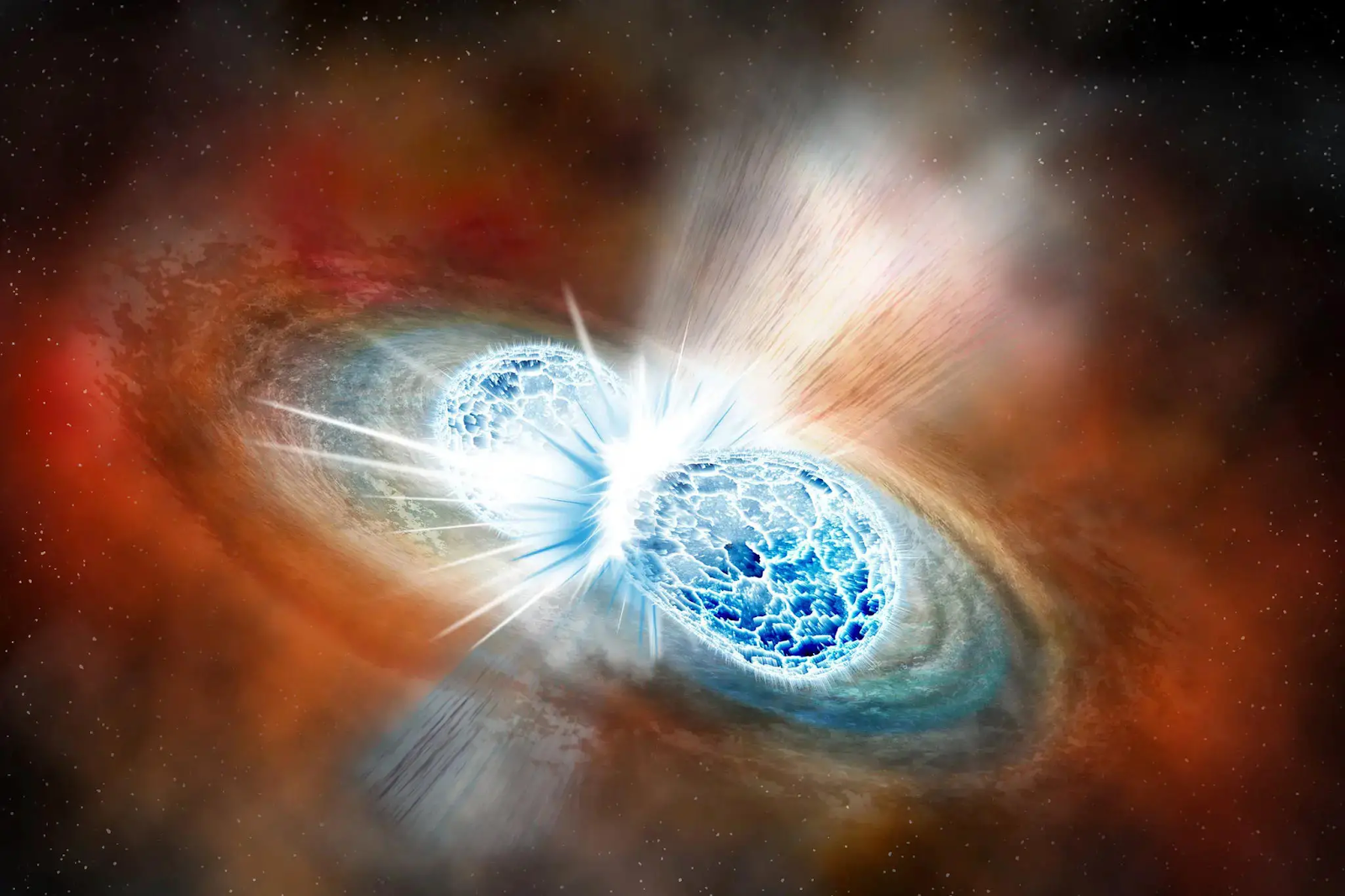
"A puzzling cosmic blast detected in both light and gravitational waves may hint at a previously unseen type of explosion, challenging astronomers to rethink how neutron stars are born and collide. Credit: Shutterstock" (ScitechDaily, Astronomers May Have Spotted a Never-Before-Seen “Superkilonova” Hidden Inside a Supernova)
"When the largest stars exhaust their fuel, they end their lives in powerful supernova explosions. These blasts scatter heavy elements such as carbon and iron into space, helping enrich the universe. A different and far rarer kind of cosmic explosion, known as a kilonova, happens when two neutron stars collide. Neutron stars are the dense remnants of dead stars, and when they merge, they can create even heavier elements, including gold and uranium. Materials like these later become part of new stars, planets, and other cosmic structures." (ScitechDaily, Astronomers May Have Spotted a Never-Before-Seen “Superkilonova” Hidden Inside a Supernova)
A kilonova is a cosmic event where two neutron stars or a neutron star and a black hole will collide. The kilonova can also happen when more than two neutron stars collide. Superkilonovas are events where the energy level of kilonovas is much higher than in regular kilonovas. Those events are infrequent. Superkilonovas are a hypothesis that more than two neutron stars impacting is still a possibility.

"This artist’s concepts shows a hypothesized event known as a superkilonova. A massive star explodes in a supernova (left), which generates elements like carbon and iron. In the aftermath, two neutron stars are born (middle), at least one of which is believed to be less massive than our Sun. The neutron stars spiral together, sending gravitational waves rippling through the cosmos, before merging in a dramatic kilonova (right). Kilonovae seed the universe with the heaviest elements, such as gold at platinum, which glow with red light. Credit: Caltech/K. Miller and R. Hurt (IPAC)" (ScitechDaily, Astronomers May Have Spotted a Never-Before-Seen “Superkilonova” Hidden Inside a Supernova)
But. Those events have not seen yet. But. In some other cases, the massive star can explode as a supernova. That star can form two neutron stars that merge immediately. Or in some other models, in a binary star. There, the neutron star and massive star orbit each other. Massive star explodes as a supernova. The neutron star pulls that nebula onto its shell. And another star also leaves a neutron star behind it.
"This artist’s animation shows a hypothesized event known as a superkilonova. A massive star explodes in a supernova, collapsing into a stellar core that forms two neutron stars. The neutron stars spiral together and merge, sending gravitational waves rippling through the cosmos and seeding the universe with heavy elements, such as gold and platinum. Credit: Caltech/K. Miller and R. Hurt (IPAC)" (ScitechDaily, Astronomers May Have Spotted a Never-Before-Seen “Superkilonova” Hidden Inside a Supernova)
Those events cause a situation in which neutron stars collide in the materia nebula, and that raises the kilonova’s energy level. The idea is that when a neutron star merger happens in a high-energy supernova remnant. That thing can raise. Its energy level. Sometimes. In the supernova remnants, there are neutron stars or magnetars. That seems too light. That thing can happen if something crushes the star from the outside.
Things like other supernova explosives, material jets from black holes, or neutron stars can trigger a supernova explosion. In cases, there. The outer layer in the escaping material. It turns too hot. This means. The outer material energy level. Turns higher than the center. That energy can force a nebula fall into the middle of the star. If. The energy level in a star’s outer shell turns higher than the temperature in its core. That thing causes an effect. The stellar shell packs material into its core.
If a planet’s atmosphere. Gets a very high energy impulse. That can cause a situation where the ultra-hot atmosphere presses. That planet is in an extremely dense form. In the cases that. There are lots of hydrocarbons. The planet. It can turn into a miniature white dwarf. Or. Planet-weight diamond. If that kind of energy impulse hits a white dwarf, that thing can turn it into “too light” a neutron star. The massive energy burst can also. Press planets into black holes.
https://scitechdaily.com/astronomers-may-have-spotted-a-never-before-seen-superkilonova-hidden-inside-a-supernova/