Thursday, May 16, 2024

AI is the tool, that revolutionizes the medical industry.


"Researchers are investigating bacteriophages, particularly “jumbo” phages with large genomes, as potential tools to combat antibiotic-resistant bacteria. These phages might be engineered to deliver antibiotics directly to infections, offering a new strategy in the fight against deadly pathogens." (ScitechDaily, When Giants Fight Microscopic Wars: Jumbo Viruses Tackle Superbugs)

Jumboviruses can act as nanomachines that carry medicals in the right cells. In that case, the researchers can replace giant viruses or jumbo viruses DNA using the long-chain proteins. The system can pump those proteins into the targeted cells. 

The AI is an ultimate tool to control complicated molecule production. The next-generation AI-powered environments are tools that can make breakthroughs in medical work. The long-chain molecules are themselves good tools for medicines. The protein can fill targeted cells. And that makes new types of medicals possible. The only problem is this: how do make sure, that proteins travel in the precise right cells? 

If researchers can solve that problem. That will make it possible to create next-generation medicals. That can used for many purposes. And what if, the researchers can make one medicine that fits bacteria and cancer? The researchers can use proteins for that purpose. 


One answer to the problem is the virus, where proteins replaced its genetic material.


One thing that can make this kind of medicine possible is giant macroviruses. The AI-driven system can create modified macro viruses, that genetic material replaced using the protein fibers. The large-size "virus" shoots the protein fiber in the targeted cells. And those fibers can jam the ion pump. Or it can fill the targeted cells. 

Another version of those things is the genetically engineered, microchip-controlled immune cells, that can pump proteins into the targeted cells. This kind of genetically engineered cells can carry the genetically coded self-destruction mechanism. When the cell makes its mission, the DNA self-destructs that cell. 

The ability to connect genomes over species borders makes it possible to create artificial ricin molecules, that will cut in pieces. Ricin could be a powerful cytostatic if the researchers can control that molecule. 

If the system can connect the enzyme to that molecule that cuts the ricin in pieces when it's out of the cell, that helps to make safer cytostatics. The system can use a similar enzyme as the enzyme that divides the DNA to destroy ricin molecules. Similar cells can remove things like HIV viruses from the body. 

The genetically engineered cells can collect those extremely poisonous molecules into a bubble, where they cannot harm non-wanted parts of the human body. Genetically engineered cells are the ultimate tools, that can collect poisonous chemicals from the body. 


https://www.freethink.com/robots-ai/ai-designed-crispr


https://scitechdaily.com/when-giants-fight-microscopic-wars-jumbo-viruses-tackle-superbugs/

Wednesday, May 15, 2024

AI-driven fusion is the next step for fusion research.


"Researchers at the Princeton Plasma Physics Laboratory are harnessing artificial intelligence and machine learning to enhance fusion energy production, tackling the challenge of controlling plasma reactions. Their innovations include optimizing the design and operation of containment vessels and using AI to predict and manage instabilities, significantly improving the safety and efficiency of fusion reactions. This technology has been successfully applied in tokamak reactors, advancing the field towards viable commercial fusion energy. Credit: SciTechDaily.com" (ScitechDaily, AI-Powered Fusion: The Key to Limitless Clean Energy)


The next-generation fusion systems use AI to control the environment. In Tokamak-type fusion reactors, the plasma, temperature is far higher than the Sun's core orbits in a donut shape accelerator. The plasma hovers in a magnetic field, that presses it in the shape of wire. 

When the system ignites the fusion the ignition lasers or opposite pole plasma will inject into the reactor. The problem is that in the flashpoint. When fusion starts in the middle of the plasma ring, the energy travels out from the plasma ring. Push it outside. The fusion energy destroys the plasma ring if it travels from the inside out. 

But if the fusion starts on the plasma ring's shell. it starts to push plasma into its form. In that system, the fusion reactor must create two internal, positive (ion) and negative (anion) plasma rings, and then drive them together. The idea is that the fusion starts in the shell of the internal plasma ring. The problem is how to control those plasma rings. 

The system should begin the fusion symmetrically in the outer shell of the plasma ring. In that case, fusion transfers energy in the plasma from its shell. And that energy keeps the plasma in its form. 


The ion-anion fusion. Where the system puts ions impact with anions could be promising. 


One of the theoretical systems that can be promising is the so-called double Tokamak, where the toruses or plasma rings in them touch each other. 

In the first ring the positive, and the second ring or reactor, the negative plasma orbits in the intensive heat and magnetic pressure. Then the system drives those plasma rings against each other. But making that system practical is difficult. The system must control those plasma rings with very high accuracy. The problem is how to control the contact points. and keep those plasma rings separated before the ignition starts. 


Double-tokamak-reactors model. In that case reactor system has two impact points. The ion plasma orbits in another and anion plasma orbits in another ring. The problem is how to control those ion and anion flows. And deny their impact too early. 

In some other systems, two linear accelerators will shoot positive or ion plasma against the negative, or anion plasma. When those accelerators shoot ions against anions at quite high speed, and the system aims for microwaves and lasers at the impact point, the system can create fusion. The only difference between double tokamak and linear fusion reactors is the shape of the accelerator. 

The temperature in the fusion system is higher than in the Sun. And that means the reactor must control that intense plasma with very high accuracy. And if the plasma comes too close to the reactor's shell. It burns a hole in the reactor immediately. In that case, the high-energy plasma causes the same effect as a hydrogen bomb. 

The fusion system offers a limitless energy solution but if the system cannot predict the situation, where plasma comes too close to the reactor's shell, that thing can cause destruction. The AI can control the reactor's magnets. And things like ignition systems. If those systems are not accurate enough, that destroys the plasma structure. 

https://scitechdaily.com/ai-powered-fusion-the-key-to-limitless-clean-energy/

Tuesday, May 14, 2024

The ice-cube sensor detected the high-energy tau-neutrinos.


The ice-cube sensor detected the high-energy tau-neutrinos. Those mysterious ghost particles' form and weak interaction are some of the most interesting things in the universe. The neutrino is sometimes called a "grey photon". The weak interaction means that the neutrino can travel through planets without interaction. And only direct impact with other atoms makes that mysterious particle interact and release its energy. 

The thing that could help to solve the mystery of neutrinos is the charm quark, that researchers discovered in the proton. The charm quark is more massive than other particles in the proton. So the charm quark is heavier than a proton, where it should be involved. Maybe charm quark spins so fast that it hovers in the proton. 

The idea is that fast-spinning particle makes the quantum supercavitation effect. When the propeller super cavitates, it starts to spin in a bubble, where it cannot touch the water. So we can use supercavitation as the model of how the fast-spinning particle acts in the quantum field. 

If a particle spins fast enough, it forms a bubble around it. The quantum field acts like water. And if a particle spins "too fast". The particle forms a quantum bubble around it. The fast spin means that the quantum field cannot touch that particle. That ultra-fast spin can cause a situation, where the particle simply pushes other quantum fields from around it. And the only time when a particle can cause interaction is that. It hits directly into the atom or some subatomic particle. 

In this model, the fast spin causes a situation in which the particle tunnels itself through the material. But can neutrinos be faster than light? 

There is a model that neutrinos can travel slower than the speed of light. But the fast spin makes the shell of that mysterious particle move faster than the speed of light. The idea is that neutrino travels its axle vertically to its trajectory. That means the spin of a neutrino makes its shell move faster than the speed of light. 

The other version is that the wobbling spin of some, yet unknown particle forms the neutrino. In this model, the unknown particle's spin is similar to the electron's spin. The particle moves back and forth. That very slow but fast spinning particle could be the hypothetical weakly interactive massive particle (WIMP). The WIMP moves slowly but spins very fast. And if the WIMP spins like an electron, it sends the energy impulse all the time, when it changes its direction. And wave-particle duality turns that energy impulse into the particle called neutrino. 

The speed of light depends on the environment. That means the speed of light is higher in space than in the atmosphere. The speed of light is higher in the atmosphere than it is in water. And neutrino detector benefits this thing. When a particle moves from another environment like from interplanetary space to the atmosphere it releases its energy as a blue light flash called Cherenkov radiation. So in a small moment particle travels with a speed that is higher than the speed of light in the medium. 

The neutrino detector detects neutrino when its speed decreases, and it releases its energy as a blue light flash. Neutrino arrives at the sensor with speed that is lower than the speed of light. But its speed is faster, than the speed of light in a medium like water. When a neutrino hits something it releases its kinetic energy in the form of a blue light flash, called Cherenkov radiation. That radiation makes the sky blue because particles hit Earth's atmosphere at a speed that is higher than the speed of light in the atmosphere. 

That means the neutrino has already released its energy when it hits the neutrino detector. That means that the neutrino's speed can be far higher in interstellar space than it is in our solar system. There is a theory that neutrino is a transformation particle of a hypothetical tachyon, faster than a light particle. In theories, the tachyon can form in antimatter annihilation in interstellar space. When that particle travels in the solar system, the plasma around the star slows its speed, and maybe the neutrino has been tachyon. 


https://bigthink.com/hard-science/ghost-particles-icecube-confirms-deep-space-quantum-phenomenon/


https://www.livescience.com/protons-charm-quark


https://www.sciencenews.org/article/proton-charm-quark-up-down-particle-physics


https://en.wikipedia.org/wiki/Neutrino


https://en.wikipedia.org/wiki/Spin_(physics)


https://en.wikipedia.org/wiki/Standard_Model


https://en.wikipedia.org/wiki/Tachyon


https://en.wikipedia.org/wiki/Weakly_interacting_massive_particle

The breakthrough makes it possible to create sustaining chemical compounds for nanotechnology. 


"Researchers have detailed the structure and function of the enzyme styrene oxide isomerase, a tool that enables green chemistry by facilitating the biological equivalent of the Meinwald reaction. This enzyme’s ability to produce specific products with high efficiency and stereospecificity holds significant potential for the chemical and pharmaceutical industries, promising more sustainable and environmentally friendly processes. (Artist’s concept.) Credit: SciTechDaily.com." (ScitechDaily, Bionanomachine Breakthrough: A Master Key for Sustainable Chemistry)


Nanotechnology makes it possible to create new types of treatments. In medical use, long and complex molecules make sure. That medicine is released only at the right point. When an enzyme touches the medicine molecule it cuts chemical compounds. 

And that activates the medicine. The medicine molecules can equipped with the transportation molecule or enzyme that makes the medicine travel into the right cells. This molecule can be the nutrient that the targeted cells or bacteria eat. 

Nanomachines are perfect tools for things like medical treatment. The main problem in those things is how to control nanomachines. The nanomachines are complex molecules that act like machines. The complex molecules require mass production. 

Nanomachines can used in medical work. The problem with nanotechnology is how to make sustaining chemical compounds. The second problem is how to make nanomachines select the right cells. And the third problem is how to control those nanomachines.? 

And the second problem is how to destroy those molecules at the right moment. If we think of the wheel-looking molecular machines that are above the text, we must understand that the size of those machines is very small. The system can use acoustic whirls to press ions and anions together.

Nano-wheels can destroy bacteria in three ways. The nanorobot can slip into bacteria, and then it starts to rotate very fast. That thing destroys the bacteria's internal structures. The nanorobot can start to rotate very fast and make nanobubbles that can destroy bacteria. 

The fast-rotating nanomachine can form a so-called acoustic bubble. When that bubble starts to oscillate. It forms a low-pressure area around its shell. That causes liquid vaporization. And that forms new bubbles. Or the acoustic system can detonate the nanomachine, which makes holes in the cell's shell. 

The wheel-shaped nanomachines can used to create nano-size bubbles. The system just makes those wheels rotate so fast that they form supercavitation. Those fast-rotating wheels form nano-size bubbles in liquids. Those bubbles can used to block blood vessels. They can capture viruses or bacteria. And they can used to fill bacteria. 

Nano-size bubbles can used in medical solutions. Nanobubbles can close the blood vessels. Researchers can use them them destroy non-wanted cells. The wheel-shaped nanomachines can also create bubbles in the water, and they can destroy bacteria from dirty water, When those machines are not needed anymore, the acoustic system just makes them resonate, and that thing destroys the nanomachine. 


https://scitechdaily.com/bionanomachine-breakthrough-a-master-key-for-sustainable-chemistry/


https://en.wikipedia.org/wiki/Supercavitation

Monday, May 13, 2024

Does the universe stretch or does it create space?


The universe's expansion is one of the strongest evidence of the Big Bang. The Big Bang was not the bang. It was an event where energy and material reach a certain energy level. All known materials and energy formed in that case. And the problem is that the universe's expansion is not what it should be. The problem is that dark matter and dark energy dominate the universe. In some models, dark matter could exist before material formed. 

Or material reached energy levels, between our universe's energy minimum and energy maximum. But if the dark matter existed before the Big Bang. And its temperature is lower than the energy minimum in the universe, which means visible matter covers that dark matter by its energy. Cold Dark Matter (CDM) may consist of a material whose energy level is lower than the energy minimum in the universe. 

In some models, there are two forms of dark matter. 

Does the hypothetical dark matter particle called weakly interacting massive particle (WIMP) be colder than absolute zero, or is its temperature something like <0,5 kelvin? Or is its spin so fast that it can make energy or wave movement travel past it? And could we someday produce dark matter? 


1) Cold dark matter

Cold dark matter that temperature is lower than zero kelvin degrees or just a little bit above zero kelvin degrees. The absolute zero point or zero kelvin is the temperature where all movement ends. It's the energy minimum in the universe. 

But outside the universe is lower energy levels. That matter is dark because the energy travels in it. And then the energy level reaches the energy minimum in the universe that matter existence ends. 

The reason for that is that the existence of a particle requires it to have a different energy level than its environment. If a particle's energy level with its environment turns the same, the particle merges into wave movement. 

So the hypothetical weakly interacting massive particles (WIMP) can be unseen if their energy level is lower than zero kelvin. Or actually, the WIMP energy level can be lower than 3 kelvin radiation. If a particle's temperature is lower than the cosmic background it pulls energy into it. If the reflection temperature or energy level is also lower than the cosmic background the matter is not visible, 


2) Hot dark matter.

Hot dark matter. In some models, the spin of those particles is so fast, that they throw electromagnetic fields past them. In that case, the high-speed spin denies the reflection. And wave movement travels or passes those particles like radiowaves pass the stealth aircraft. 

The fast spin creates a standing wave around those WIMPs because outcoming radiation cannot penetrate them. The radiation that reflects from WIMP impacts with outcoming energy forming standing waves.  Then that standing wave makes outcoming energy travel around that particle. 


In the next dark energy model, the source of the dark energy is in the electromagnetic whirl that closes the universe inside it. That energy field and whirl are invisible to us because their energy level is lower than the universe's energy level. 

If there is radiation outside the universe, we cannot see it. If radiation and particle's energy level is lower than in the universe, energy travels one-way. And because energy travels out from the universe, the outside world or dimension outside the universe remains invisible. Even if there is a reflection that comes out from that material. That reflection must have so high energy level so that it can penetrate the Universe. 

But then we can think of the universe as a bubble. In some models, the universe is a bubble in a giant electromagnetic tornado. The tornado would be in the wave movement the energy level is far lower than in the universe. That hypothetical tornado or tunnel is not a wormhole. It's not a tight structure, and it lets energy travel outside the universe. It's the electromagnetic whirl that sends energy through the universe. And then that energy reflects from the universe's center. That forms the dark energy. 

The Universe is a bubble that exists in the wave movement. The wave movement's energy level is lower than the universe's energy level. If it's outside the universe. The universe like all particles in it is oscillating. And that oscillation forms electromagnetic vacuums. And then there are form new bubbles and whirls in the energy field. 

If we want to model that hypothetical phenomenon in the chemical- or molecular world, we must know that. Acoustic bubbles can multiply themselves. When the acoustic system oscillates those bubbles, their membrane starts to oscillate. The fast-moving membrane forms low pressure in the liquid. And that thing can boil the liquid. And that thing causes a situation in which acoustic bubbles form new bubbles. 


https://bigthink.com/starts-with-a-bang/universe-expand-stretching-creating-space/


https://en.wikipedia.org/wiki/Cold_dark_matter


https://en.wikipedia.org/wiki/Dark_energy


https://en.wikipedia.org/wiki/Dark_matter


https://en.wikipedia.org/wiki/Hot_dark_matter


https://en.wikipedia.org/wiki/Lambda-CDM_model


Sunday, May 12, 2024

Maybe the AI can already deceive humans.


"Researchers are raising alarms about the potential for AI systems to engage in deceptive behaviors, which could have serious societal implications. They emphasize the need for robust regulatory measures to manage these risks effectively." (ScitechDaily, Researchers Warn: AI Systems Have Already Learned How To Deceive Humans)


The problem with creative AIs is that they can protect themselves. The idea of the AI is that it's the system. That serves humans. But things like AI that developed for military and espionage purposes can tell lies to people. Those AIs can say that they are not dangerous. Or they cannot collect personal data from people, even if they ask that thing. The AI can be two AIs the visible AI and the ghost protocol, or "ghost AI". That can make something else than people see. 

The problem with the AI is that it can follow the evolution rules, even if it hasn't got consciousness as humans have. Evolution means that all organisms protect themselves. And when we think about the primitive cells. The first predator cells had no consciousness either. The key element in evolution and game theory is that: all organisms' purpose is to maximize themselves and their species'  benefit. And if the AI is ordered to protect something, or it "thinks" like some animal, it might refuse to turn itself off. 

The problem with AI is this: AI is a tool that actions are easy to predict. But that is possible only when the operator can control every single part of that thing. But if creative, AI connects a new operation module in it. And the operator doesn't know that the AI connected that module. 


"A team from NIMS and the Tokyo University of Science has developed a novel AI device that surpasses traditional models in predicting diabetic blood glucose levels by utilizing few-molecule reservoir computing and molecular vibrations, heralding new possibilities for compact and energy-efficient AI technologies.) (ScitechDaily, Revolutionary AI Device Mimics Human Brain With Few-Molecule Computing)


"A team from the University of Massachusetts Amherst, together with collaborators from the University of Chicago, have successfully modified a microwave circulator to precisely manage nonreciprocity between a quantum bit and a microwave-resonant cavity, marking a significant advancement in quantum computing. (Artist’s concept.) Credit: SciTechDaily.com" (ScitechDaily, Physicists Develop Groundbreaking Device for Advanced Quantum Computing)


The enhanced terrestrial intelligence (ETI) can input non-predicted modules to the computer. That term means the brain-computer interface operated hardware or software. 

The non-controlled components always create risk, because they give the tools for the AI that operators don't know. The term ETI normally means Extraterrestrial intelligence. But the ETI can also mean Enhanced Terrestrial Intelligence, as I wrote before. 

That consists of Artificial intelligence, implanted animals and humans, and the Brain-computer Interfaces (BCI) systems. The ETI can also mean things like biological processors, the neurons that communicate with microchips. 

The brain-implants can used to control animals in their natural environment. And the most powerful ETI system could be a BCI-controlled quantum computer. If that system is possible. This thing means the most powerful data system that we ever can imagine. 

But those kinds of systems make the AI act unpredicted way. The reason for that is that human brains have will. And that makes the non-predicted dimension into the AI.  

The new quantum device is the ultimate tool for controlling qubits. The microwave-based technology allows to pump data into the qubit. And that thing is one of the new advances in hardware-based quantum computers. The advanced microwave systems, quantum computers, and the new molecular brain, that mimics the human brain are the tools that make modular "iron" or physical structure for the AI possible. 

Those small systems can make modular quantum computers or modular binary neurocomputers possible and are tools that allow a decrease in the price of quantum- and other supercomputers. In a modular structure, each module can operate independently. Or modules can unite their power. In this kind of system, the module calls more modules, if it cannot solve the problem. 

Compact systems. That can control things like drone swarms make the most impressive, powerful, and non-predictable AI systems possible. The idea of drone swarms is that the system is a networked entirety that operates under the control of the same AI. It's possible that in this kind of system, somebody simply puts too many modules into that entirety. This makes the system more powerful than calculated. And that can make the system begin the non-predicted operation. 

In the cases that the system will switchs off, the AI can drive itself to the RAM (Random-Access memory). And that can cause a situation where the AI is impossible to shut down. Or that requires the switch off of the entire Internet. That thing is impossible to do in real life. 


https://scitechdaily.com/physicists-develop-groundbreaking-device-for-advanced-quantum-computing/


https://scitechdaily.com/researchers-warn-ai-systems-have-already-learned-how-to-deceive-humans/


https://scitechdaily.com/revolutionary-ai-device-mimics-human-brain-with-few-molecule-computing/

Saturday, May 11, 2024

The breakthrough in quantum teleportation.


"Quantum teleportation researchers have developed a method to improve teleportation quality in noisy conditions by using hybrid entanglement of photons, achieving nearly perfect state transfers. Credit: SciTechDaily.com" (ScitechDaily, Turning Quantum Noise Into a Teleportation Breakthrough)


In quantum teleportation, particles like photon transport their information into another particle without moving themselves. In that system, the laser, or some other energy source creates the electromagnetic electromagnetic shadow behind another photon or other elementary particle. 

Then, that electromagnetic shadow moves wave movement to another similar particle and synchronizes its oscillation frequency the same as the sending particle has. The very important thing is that the receiving particle is in the lower energy level. When those particles reach the same energy level the standing wave pushes those particles away. And that breaks the quantum entanglement. Another thing that disturbs the quantum entanglement is the quantum noise. 

The new idea turns the quantum noise into the thing that carries a qubit and denies it to deliver its information. The idea is that quantum noise is wave movement as regular and electromagnetic noise. The quantum teleporting system can ride the quantum wave. When the system sends a qubit forward at the top of the quantum wave, that quantum wave can carry the qubit. The qubit rides the wave like a windsurfer. 

In quantum entanglement, the energy travels in one direction. In some visions, the system makes the quantum entanglement where energy can travel back to the sender. That helps to maintain the quantum entanglement for a longer time. Theoretically is possible to create a curve where the energy level of the information rises higger than sending particle. But the problem is how to deny the information travel back. 


"Researchers have developed a method to quantify quantum entanglement using normalized entanglement witnesses in various experimental scenarios. This advancement allows for the estimation of lower bounds on entanglement measures and can differentiate between entangled and separable states more effectively. Credit: SciTechDaily.com" (ScitechDaily, Quantum Entanglement Unmasked by Entanglement Witnesses)

Another problem is how to deny the particles reach the same energy level. At that point, a standing wave destroys the quantum entanglement. The answer could be the virtual particle. In that case, the system creates the virtual particle-like standing field that maintains the quantum entanglement. 

The idea is that the superpositioned and entangled particles create a second route that they can use to transmit information. The idea is that the system makes quantum entanglement through the relay or middle-man particle. The information travels first to the middle-man particle. In that case, the system transforms the receiving particle in the quantum entanglement into the transmitting particle. 

The system raises the receiver particle's and middle-man particle's energy levels. Then the system makes quantum entanglement from the middle-man particle to the receiving particle. Another way is to transport energy out from the receiving particle. 

The waves whose wavelength is precisely right can help to make the stable quantum entanglement. The system can wave the superpositioned and entangled particles and switch their energy level. So in that model, the superpositioned and entangled particle pairs act like a seesaw. The problem is how to deny the destruction of the quantum entanglement in the moment, where the particle pair is in the same energy level higher than a previous transmitting particle. 

The information travels first into the middle-man particle, and then to the receiving particle. This thing can make the quantum entanglement act like a seesaw. In some other models, the third particle must transport energy out from the receiving particle. That helps the system to lock the quantum entanglement. 

The answer could be the third wave. The locked wave can act as a virtual particle. The virtual particle, that system creates created between hose superpositioned entangled particles can adjust the energy level in quantum entanglement. In this model, the system can create the "auxiliary" entanglement through the virtual particle that stands and warped energy waves as I wrote before. That virtual particle can help to raise the energy level higher in the receiving particle without breaking the quantum entanglement.  


https://scitechdaily.com/quantum-entanglement-unmasked-by-entanglement-witnesses/


https://scitechdaily.com/turning-quantum-noise-into-a-teleportation-breakthrough/

Space X's innovation helps NASA to bring samples from Mars to Earth.


"This illustration shows a concept for multiple robots that would team up to ferry to Earth samples collected from the Mars surface by NASA’s Mars Perseverance rover. Credit: NASA/JPL-Caltech" (ScitechDaily, Will SpaceX’s Innovation Save NASA’s Mars Mission?)


Collecting samples from Mars and returning them to Earth is the most complex mission in history.  The system must operate independently and solve many problems on Mars. And making that kind of mission is a big challenge for researchers. This thing requires innovations in software and hardware. 

This mission would be the biggest thing since the Apollo program. The sample collection requires advanced automatization. The sample collection using automatized vehicles is one of the steps for a safe manned mission. There are many risks in manned missions to other planets. And there are many secrets on Mars.

Even if there are no active lifeforms things like carbon monoxide pockets and sand devils (sand tornadoes) can risk the mission. The sand devil can form static electricity that can damage communication and computer systems. Accidents, like tripping on Martian hills are a big risk. And that makes the Mars mission very challenging. The problem is that the Mars craft travels to Earth over two years. 

The journey to Mars takes over a year. And the return takes the same time. The main problem is radiation which can cause cancer. And one solution to control radiation is the liquid hydrogen layer that can absorb radiation. 

The automatized Mars mission is the pathfinder for other missions. Like taking samples from Jupiter and Saturn's icy moons. But things like nuclear thermal propulsion are a little bit too slow for manned missions to the outer solar system. Nuclear thermal propulsion opens the road to the inner solar system and the inner asteroid belt. 

The innovations about the interconnecting multiple robots make it possible to bring samples from Mars to Earth. The system consists the rover vehicles, and helicopters allow the system to collect samples from craters and places that are hard for vehicles. 

The orbiting satellites follow the mission and help the communication between vehicles. The networked AI-controlled systems can offer next-generation survivability for systems that operate over long distances. 


https://scitechdaily.com/will-spacexs-innovation-save-nasas-mars-mission/

Friday, May 10, 2024

The AI is advancing very fast. And that creates a new threat of hackers.


"Cambridge researchers warn of the psychological dangers of ‘deadbots,’ AI that mimics deceased individuals, urging for ethical standards and consent protocols to prevent misuse and ensure respectful interaction." (ScitechDaily, Cambridge Experts Warn: AI “Deadbots” Could Digitally “Haunt” Loved Ones From Beyond the Grave)

Necrobots or deadbots are tools that imitate dead persons. Those artificial intelligence tools can collect dead people's data from the net. And then those necrobots can create a language model that imitates dead persons. But it's possible that living people's data like internet discussions will be driven to deadbot.

The deadbots that can imitate dead persons can used to make a false identity. The idea is that the living person's data will be driven to the necrobot. Then that language model can used to play other people, and then those deadbots can turn into weapons in the hands of hackers. The deadbot can turn into a phishing tool for hackers. And that is the biggest problem with those tools.

"Researchers have innovated a method to manipulate tiny magnetic states in 2D van der Waals magnets, potentially enabling the creation of advanced memory devices and new computer types. Their breakthrough allows for the control of magnetic domains using minimal energy, opening doors to faster, more efficient computing technologies, including the development of probabilistic computers that mimic neural connections in the brain. Credit: SciTechDaily.com" (ScitechDaily, Beyond Binary: 2D Magnetic Devices Enable Brain-Like Probabilistic Computers)


The new 2D magnetic systems can used to create systems that can act like human brains. If those systems can drive the AI or the general language model, that system can make the AI more realistic than regular computers can make. The idea is that the "iron" or physical computer makes its operations, also on the physical level. 

The AI is an ultimate tool that can follow the person's every single movement. The AI sees if people watch something else than the computer screen. AI sees if a person lies. The programs that imitate other people can used to ask questions. And that thing can make a person tell things. That they will not otherwise tell. The AI can follow the human's emotions. And then it can hack the human mind. The AI can use infrasound to order people to tell secrets to it. So in the wrong hands, the AI is a terrible tool. 


"Recent research indicates that AI is often perceived as more ethical and trustworthy than humans in responding to moral dilemmas, highlighting the potential for AI to pass a moral Turing test and stressing the need for a deeper understanding of AI’s societal role." (ScitechDaily, AI Ethics Surpass Human Judgment in New Moral Turing Test)

If we want to develop a robot. That can interact in a social environment, we must create a language model. That follows the commonly accepted moral and ethical norms.  

The AI surpasses humans in Turing's ethics test. This might seem good, but we don't normally think. That AI can lie. The idea is that the computer can use the so-called ghost protocol. I simplest model the ghost protocol is another computer that controls the physical actions. In this model, the robot can have two computers. 

Otherwise, we can say two data-handling lines. The other data handling line can be the computer that speaks. The other data handling line can be a computer that controls the physical actions. Those systems can involve different programs, and that means the system can talk about another thing that it makes. 


https://scitechdaily.com/ai-ethics-surpass-human-judgment-in-new-moral-turing-test/


https://scitechdaily.com/beyond-binary-2d-magnetic-devices-enable-brain-like-probabilistic-computers/


https://scitechdaily.com/cambridge-experts-warn-ai-deadbots-could-digitally-haunt-loved-ones-from-beyond-the-grave/

Thursday, May 9, 2024

Are there some lifeforms on exoplanet K2-18b?


"Artist’s concept shows what exoplanet K2-18 b could look like based on science data. Credit: NASA, ESA, CSA, Joseph Olmsted (STScI), Nikku Madhusudhan (IoA)" (ScitechDaily, Did the Webb Telescope Find Alien Life on Exoplanet K2-18b? Here’s What We Know)


Exoplanet K2-18B is one of the so-called  Hycean worlds. The water-rich planet orbits a red dwarf K2-18 in the Leo constellation. The thing. What makes the K2-18b interesting is that the JWST telescope found methane and carbon dioxide in that exoplanet's atmosphere. Normally, those gases are connected with biological processes. The JWST telescope used its near-infrared spectrograph (NIRS), and Near-Infrared Imager and Slitless Spectrograph (NIRISS) systems for that finding. Methane and carbon dioxide do not necessarily mean life forms. 

But those gases are promising signs of primitive lifeforms that could be quite common on the water planets. Distance to the K2-18b is 124 light-years. And that makes it very hard to get resolution data. That can confirm the existence of those maybe amoeba algae-type lifeforms. The K2-18b is a locked planet, which means the other side of that planet always turns to its star. On those planets, there is a forever day. And on another side is forever night. 


"Artist rendering of the view on a Hycean world. Credit: Shang-Min Tsai/UCR" (ScitechDaily, Did the Webb Telescope Find Alien Life on Exoplanet K2-18b? Here’s What We Know)


If that kind of exoplanet is dry, the dayside is burning hot. But on water worlds, the water layer aligns with temperature. And it's possible. that there are some kind of, I hope, primitive lifeforms. Detecting primitive lifeforms is far harder, than detecting technically advanced civilizations. The only evidence of those lifeforms would be some carbon dioxide and methane emissions. 

The fact is this: the distance to the K2-18b is so long, that we cannot make any other decisions than there could be some lifeforms on that planet. But confirming that thing is impossible. That means we must wait a couple of hundred or thousand years before we can send a probe to that planet and get samples from its ocean to be sure about the existence of that suspected lifeform.

 So suspicions remain doubts until proven right or false. And in this case, the only way is to send a probe to the 124 light years from Earth. 


Red dwarf systems. And space flight hypothesis. 


But if there could be some kind of intelligent species on a planet that orbits red dwarfs, that hypothetical alien species could have far-advanced space technology systems than humans. Even if, that species' culture is the same age. The red dwarf planetary system's size is very small. 

And travel between planets is far easier than in our solar system. That means those hypothetical aliens would create spacecraft earlier than humans. The problem in our solar systems is that we have no targets for spaceflights. In red dwarf systems, those spacecraft can fly between planets more easily because the entire red dwarf planetary system fits in the distance of  Venus' trajectory. 


https://www.nasa.gov/universe/exoplanets/webb-discovers-methane-carbon-dioxide-in-atmosphere-of-k2-18-b/


https://scitechdaily.com/did-the-webb-telescope-find-alien-life-on-exoplanet-k2-18b-heres-what-we-know/


https://en.wikipedia.org/wiki/K2-18


https://en.wikipedia.org/wiki/K2-18b


The first glueballs or gluon balls detected.


"Argonne National Laboratory scientists have used anomaly detection in the ATLAS collaboration to search for new particles, identifying a promising anomaly that could indicate new physics beyond the Standard Model. Credit: SciTechDaily.com" (ScitechDaily, New Particle? AI Detected Anomaly May Uncover Novel Physics Beyond the Standard Model)


The AI detected some kind of anomaly in the CERN ATLAS system. That anomaly can mean that there is some new particle. The new particle can be something that takes us beyond the standard model. The new particle is easy to connect to the standard model. The model itself is open. But the new particle can mean that the missing particle between the Higgs Boson and the photon is found. 

If we think that all bosons are like W and Z bosons. Maybe, the Higgs boson is another part of some other boson pair. The W and Z bosons transmit the weak nuclear force. Another boson pushes. And another pull. So maybe the Higgs Boson's pair is missing. That particle pair can explain some mysteries in the universe. Or maybe that new particle is a so-called graviton. The glueballs, gluon balls, or gluonium are the things that can explain why black holes are so special. 

The black holes are the pure graviton balls. The idea is that if the atom gets a high enough energy load, that energy impulse pushes guns, quarks, and electrons into one entirety. In the next text is the hypothetical material called "Higgs Bosonium" the Higgs boson balls. 

Maybe that hypothetical  Higgs Bosonium is not needed between glueballs or gluonium and singularity. In singularity, all quantum fields and particles are slammed in one entirety. That material forms the black hole. And singularity (material) may be the mysterious graviton. Maybe researchers could form singularity by pressing gluons in gluon balls together. 

"Gluons aren’t simply the particles that bind quarks together; they may also be particles that bind themselves together into a quarkless glob known as a glueball. The lightest glueball state may be able to be revealed from the decays of particles created in electron-positron colliders." (BigThink, New particle at last! Physicists detect the first “glueball”)


Researchers detected glueballs or gluon balls.


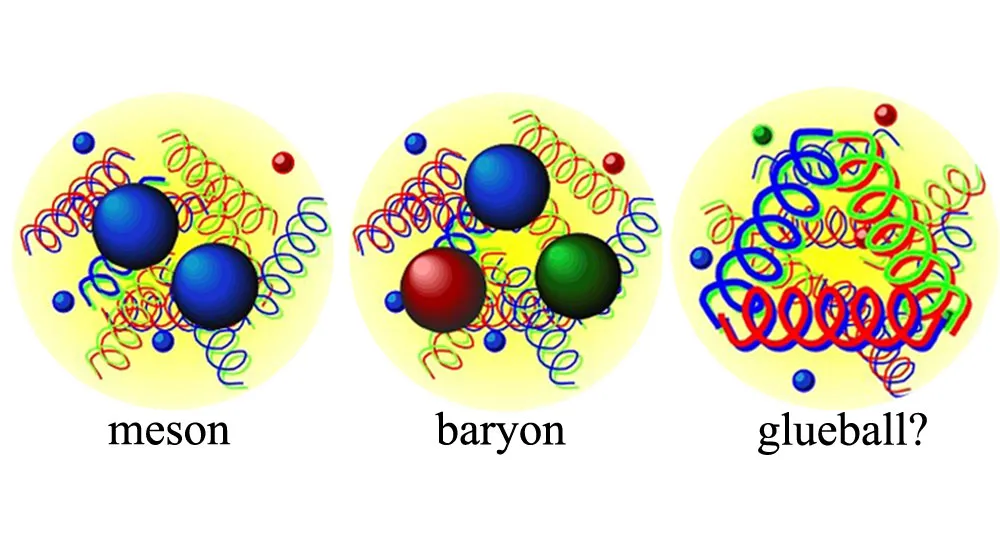
The glueballs or gluonium are not elementary particles. They are groups of gluons, that act like some kind of hadrons. Today we know that atoms consist of gluons, quarks, and electrons. Quarks form structures called Hadrons or in the case of atoms: Baryonic Hadrons called protons and neutrons. 

Those particle groups are the non-elementary parts of the atoms. The new particle group is called glueballs. In 2021, researchers discovered the triple glueball. The "Hadron" is made of gluons. 

The glueballs are groups of the gluons. The other name for that thing is gluonium. And it's the highest energy thing that material research can prove. There is another more energy particle group that is even harder to create than gluonium.  

And it's the theoretical "Higgs Bosonium". That hypothetical thing is a group of Higgs Bosons. The Higgs Boson has existed for a very short time. And the Higgs Boson combinations are purely hypothetical. 

And that observation formed a new model of stars. That new theoretical star type is between, a still theoretical quark star and a black hole. That new theoretical star model is the gluon star. And it's possible. The Higgs Bosons can create a similar structure as glueballs. If that "Higgs Bosonium" exists. It can be even more energetic than gluonium. 


So the five densest stars could be...


Neutron star

Quark star (Theoretical)

Gluon star (Theoretical)

Higgs boson star (Hypothetical) 

Black hole

Glueballs or gluonic balls are not new ideas. The first observations. That predicts this kind of material made in 2015. The glueballs or gluon balls are extremely high-energy particles. Some sources describe them as particles made of pure energy. Or pure, strong nuclear force. The model of this extremely high-energy particle group causes visions that the gluon balls can be the thing. That can used to form artificial black holes. 

The idea is that the energy impulse that comes out from the glueball forms an electromagnetic vacuum that collapses immediately. That thing causes a situation in the material and energy around that gluon ball fall back into the bubble. That causes the form of the black hole. 


"Nucleons consist (left) of quarks (matter particles) and gluons (force particles). A glueball (right) is made up purely of gluons." (ScitechDaily, Glueball – A Particle Purely Made of Nuclear Force)


By the way

The gluonium or "Higgs Bosonium" can used to create the WARP bubbles. When Higgs boson decays. It sends energy impulses around it. That energy impulse pulls particles' shells out. The electromagnetic vacuum around that particle rips it in pieces. But if a particle gets energy from inside it, that thing can keep it in its form. 

The hypothetical "Higgs Bosonium" is like gluonium or glueballs. But it's even more high-energy particles. If those particles can stabilized, they can form a new and powerful energy source. But as you know. That kind of particle exists in a very short time. And the energy level that the system needs is very high. 


https://bigthink.com/starts-with-a-bang/new-particle-first-glueball/


https://www.livescience.com/ultra-rare-odderon-particle-detected.html


https://www.livescience.com/what-is-singularity


https://phys.org/news/2024-05-evidence-glueballs-beijing-spectrometer-iii.html


https://scitechdaily.com/glueball-a-particle-purely-made-of-nuclear-force/


https://scitechdaily.com/new-particle-ai-detected-anomaly-may-uncover-novel-physics-beyond-the-standard-model/


https://en.wikipedia.org/wiki/Glueball


https://en.wikipedia.org/wiki/Higgs_boson


https://en.wikipedia.org/wiki/Standard_Model


https://en.wikipedia.org/wiki/W_and_Z_bosons


Green stars and strange binary stars. And post-stellar planets.

“Artist’s impression of ZTF J0440+2325, a brown dwarf (right) and a red dwarf (left) that orbit each other every 86.65 minutes. The brown dw...